Listen While You Work
Play this study as you work, drive, or rest. A simple way to keep the Word with you throughout your day, not only as a full sit-down study.
🎧 Listen to this study
Please note: this study is narrated with AI-generated audio, which may occasionally misread a Scripture reference (for example, "Acts 1 point 9" rather than "Acts 1 verse 9"). For the exact wording, please refer to your Bible.
John 2 · The New Testament World
The Wedding That Ran Out of Wine
A village feast that lasted a week. A family's honor on the line. Six stone jars meant for washing, not drinking. Step into the wedding at Cana, and Jesus' very first sign shows you exactly who He is.
Before You Read
The very start of Jesus' public ministry. "The third day," at a wedding in Galilee, His first miracle.
Rome. Tiberius Caesar as emperor, Herod Antipas as tetrarch over Galilee.
Cana of Galilee, a village in the hills near Nazareth. The exact site is not certain today.
Observant Galilean Jews. Ritual washing before and during meals, using vessels of stone.
Greek. Key words: "governor of the feast" (architriklinos), "firkins" (metrētēs), "woman" (gynai, respectful), "hour" (hōra).
Wedding feasts lasting about a week. Hospitality was a matter of family honor, and running out was a public disgrace.
The week-long bridal feast (Genesis 29:27; Judges 14:12); wine as the gladness of God's blessing (Psalm 104:15); the promised feast of abundance (Isaiah 25:6).
The Creator manifest in flesh. He does in a moment what vine and time do in a season, and reveals His glory.
Step Into the Moment
Walk Into the Feast
Day Three of the Feast
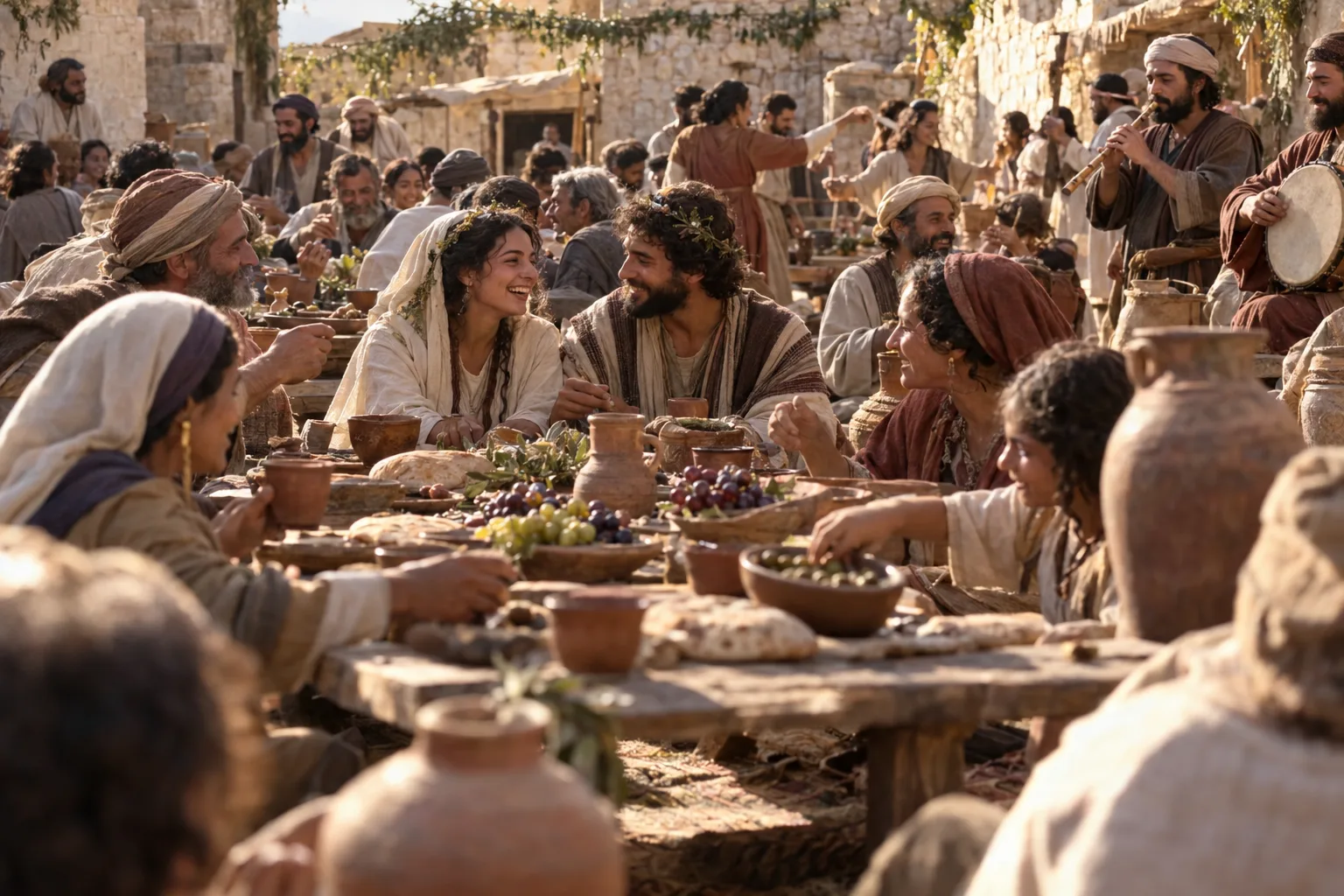
For three days now the whole village has not really stopped. Flutes and tambourines carry from courtyard to courtyard, children duck between the legs of elders who are deep in conversation, and every table stays full because someone's cousin, or someone's cousin's cousin, keeps bringing more out. This is what a wedding looks like when it is going right: loud, warm, and utterly unhurried, because everyone here knows a joy like this is not something you rush.
Somewhere Behind the Crowd
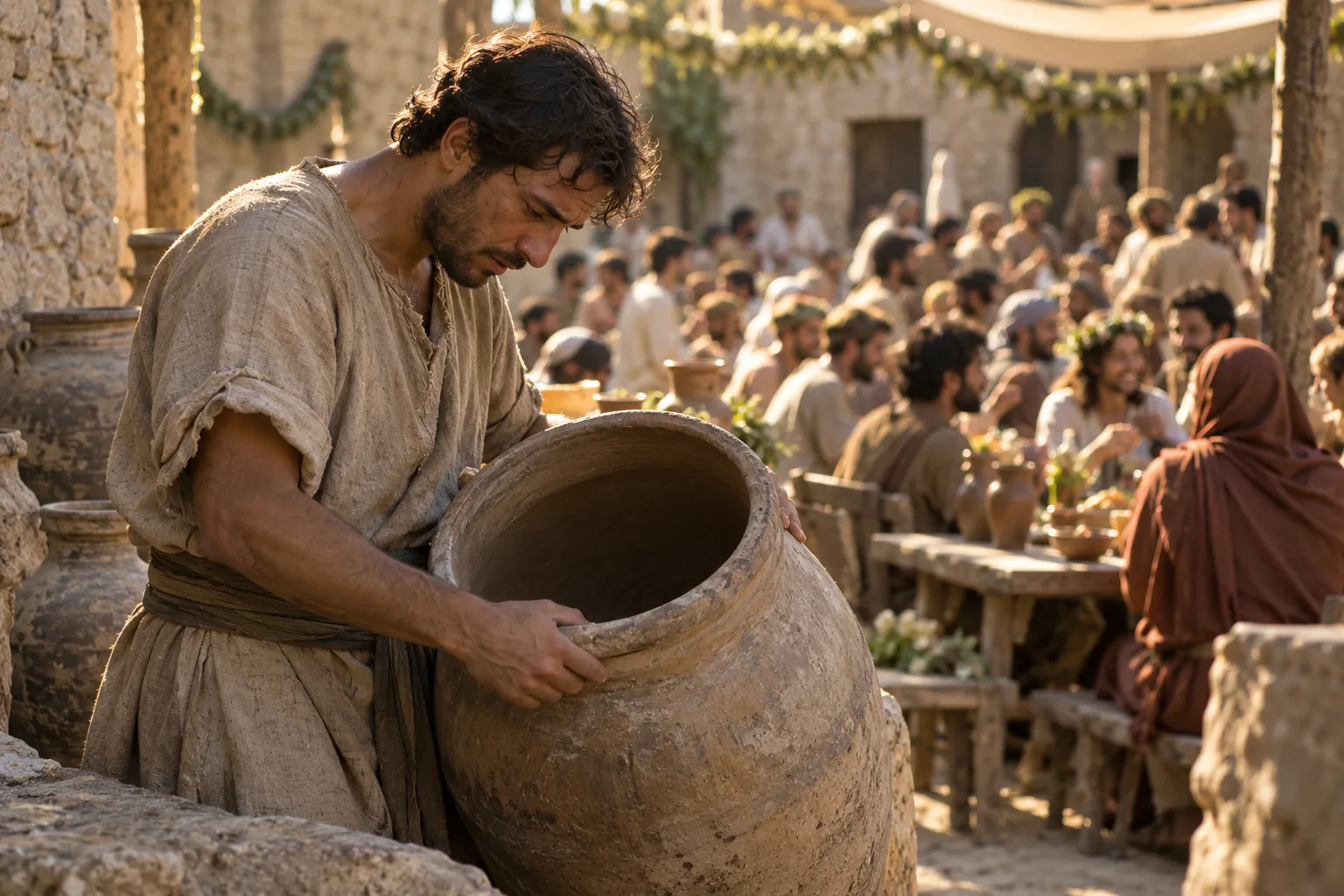
Then a servant tips the last jar and hears the one sound no host wants to hear: the hollow, dry scrape of a vessel with nothing left in it. The wine is gone. The week is not. He knows exactly what that will mean by morning, in a town this size, for a couple who have barely begun their life together.
"And the third day there was a marriage in Cana of Galilee... And when they wanted wine, the mother of Jesus saith unto him, They have no wine" (John 2:1, 3). To us it sounds like a small inconvenience, send someone to the store. To them it was a quiet catastrophe. To understand why, and to understand what Jesus did about it, you have to step into a first century Jewish wedding.
Cultural Background
A Week of Feasting, and a Family's Honor
A wedding was not an afternoon. It was the celebration of the year, and it commonly lasted about a week. This was the ancient pattern: when Jacob married, he was told to "fulfil her week" (Genesis 29:27), and Samson's wedding feast ran a full seven days (Judges 14:12).
"Fulfil her week, and we will give thee this also for the service which thou shalt serve with me yet seven other years."Genesis 29:27 KJV
For a whole week the couple were treated like a king and queen, and the community ate, drank, sang, and blessed them. The groom's family hosted, and in that world hospitality was not a nicety. It was a sacred duty and a matter of honor. To run out of food or wine partway through was not merely awkward; it was a public failure that would shame the host and follow the new couple. Providing enough was how a family showed love, dignity, and blessing over the marriage.
So when the wine gave out, the danger was real. This is why Mary brings it straight to Jesus. She is not asking for a party trick. She is trying to spare a family a wound they would carry for years.
Step Into the Moment
Filling Jars No One Expects to Hold Wine
At the Six Stone Jars
The servants have heard the instruction twice now, because it makes no sense the first time. Fill the washing jars, the heavy stone ones meant for rinsing hands and dishes, all the way to the brim, with water. Not wine. Water. They do it anyway, because the quiet man giving the order is the one his own mother just told them to obey without question, and because refusing a guest's strange request costs less than the humiliation already sitting at every table. Jar after jar, bucket after bucket, their arms ache before the last one is full to the lip. No one explains why. No one asks again.
Cultural Background
Why the Jars Were Made of Stone
John notices a detail we would walk right past: "And there were set there six waterpots of stone, after the manner of the purifying of the Jews, containing two or three firkins apiece" (John 2:6). Every word of that is loaded.
They were stone, and that was deliberate. Under Jewish ritual law, clay pottery that became ceremonially unclean had to be broken, but vessels of stone did not contract that impurity. So observant Jewish homes kept large stone jars on hand for the water used in ritual washing, of hands and vessels, before and during meals. Archaeologists have found these stone vessels all across first century Jewish Galilee and Judea, exactly the kind John describes. This is real, and it is verifiable.
These were not wine jars. They held the water of religious purification, the water of the old ceremony. Remember where Jesus chose to work, because it will matter in a moment.
The Detail That Startles
How Much Wine Did He Make?
"Jesus saith unto them, Fill the waterpots with water. And they filled them up to the brim" (John 2:7). Then the water, drawn out, was wine.
Now do the arithmetic John gives us. Each jar held "two or three firkins." A firkin, the Greek metrētēs, was roughly eight to ten gallons. So each of the six jars held something like twenty to thirty gallons, and together they held well over a hundred gallons of wine, likely more than a hundred and fifty.
Stop and picture that. The wedding had already been going for days and the wine had run out, which means the guests had drunk plenty already. And into that Jesus pours over a hundred gallons of the finest wine anyone there had tasted. This is not a careful, measured supply. It is staggering, embarrassing abundance, more than a village wedding could drink. That extravagance is not an accident. It is the point.
A fair word about the wine itself: Scripture presents wine as a genuine gift of celebration, "wine that maketh glad the heart of man" (Psalm 104:15), and just as plainly warns against drunkenness (Proverbs 20:1; Ephesians 5:18). The sign at Cana is about the glory and generosity of the One who made it, not an endorsement of excess.
At the Head Table
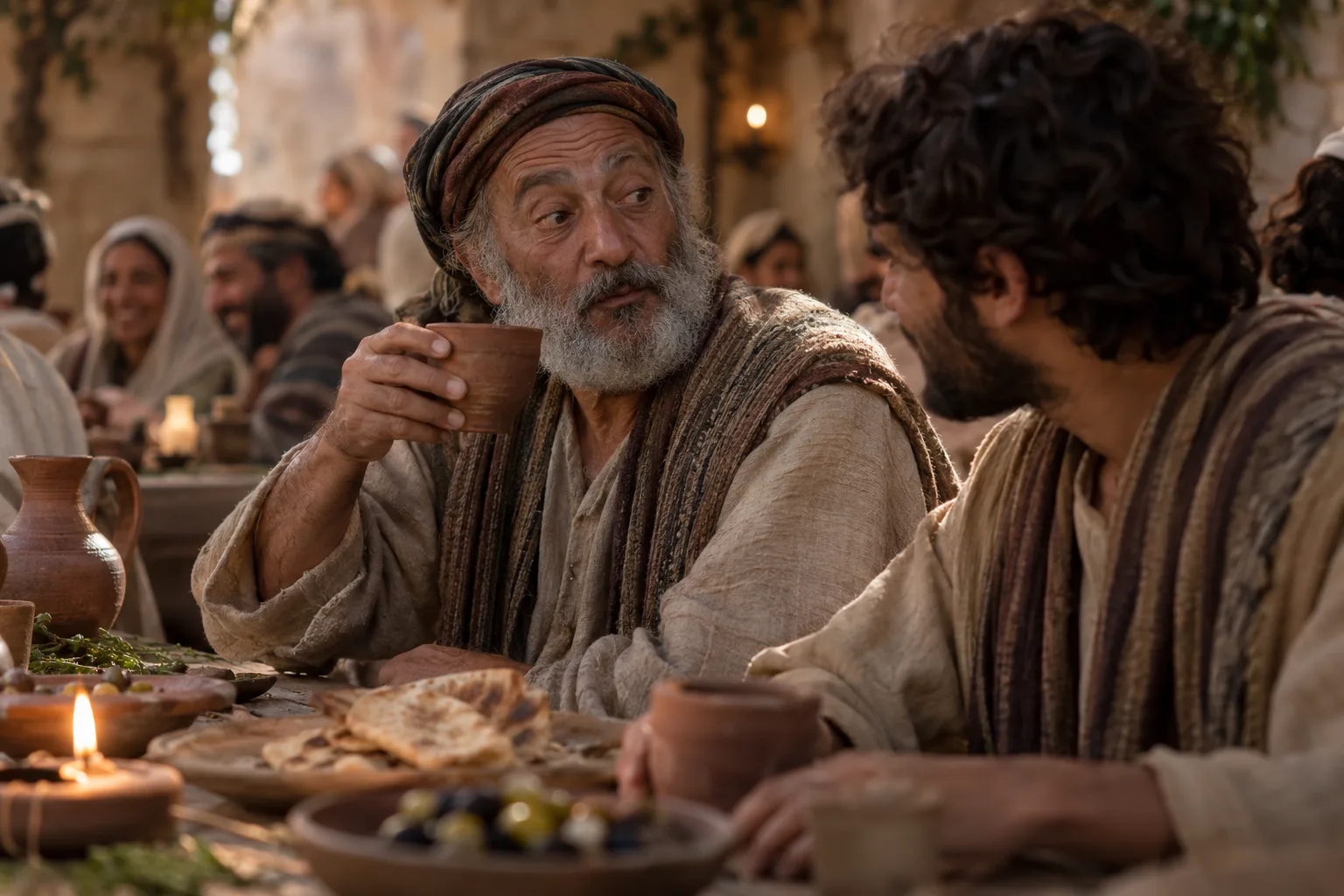
A servant hands the governor of the feast a cup drawn from one of those same stone jars, and says nothing about where it came from, because he does not know himself: "the servants which drew the water knew" (John 2:9). The governor drinks, pauses, and calls for the bridegroom with the look of a man who cannot quite finish his own sentence. "Every man at the beginning doth set forth good wine... but thou hast kept the good wine until now" (John 2:10). The bridegroom has no idea what just happened to his wedding. Only the servants, and the One who gave the order, know.
The Language
"Woman" Was Not a Rebuke
Jesus' answer to His mother sounds sharp in English: "Woman, what have I to do with thee? mine hour is not yet come" (John 2:4). Modern ears wince. But the word translated "woman" (Greek gynai) was a normal, respectful way to address a woman in that culture, the way we might gently say "ma'am." It carried no disrespect. Jesus used the very same word from the cross when He tenderly gave His mother into John's care: "Woman, behold thy son" (John 19:26).
And "mine hour is not yet come" is one of John's great themes. Again and again, Jesus speaks of His "hour," the appointed time of His cross and glory. He is gently telling His mother that His mission moves on the Father's timing, not human prompting. Yet He acts, in mercy, for this family. Mary's response is the last thing Scripture records her saying, and it still points every reader in the right direction.
"His mother saith unto the servants, Whatsoever he saith unto you, do it."John 2:5 KJV
Where It Lands
The Creator at the Feast
Think about what actually happened. Every year, God turns water into wine slowly, rain to root, root to vine, vine to grape, grape to wine, over a whole patient season. At Cana, the One who designed that whole process simply did it at once, with a word. The hands that made the water made the wine. This is why John calls it what he does:
"This beginning of miracles did Jesus in Cana of Galilee, and manifested forth his glory; and his disciples believed on him."John 2:11 KJV
The first sign is not a healing or a storm stilled. It is the Creator, quietly, at a village party, doing what only the Maker of heaven and earth can do (John 1:3; Colossians 1:16). The glory of God was standing in that courtyard in the flesh.
Do not miss where He chose to work His glory: in the six stone jars of purification, the vessels of the old ceremony. He filled the water of ritual washing and brought out the best wine of the feast, saved for last (John 2:10). The One who came in flesh was not a second God beside the Father. He was the Creator Himself, made known, turning the water of old religion into the new wine of joy that only He can give. "That which is worse" comes first in this world; God saves the good wine until now.
For You
He Cares About the Empty Jar
Notice what kind of need Jesus met first. Not a deathbed, not a demon, but a very human, almost embarrassing social crisis, a family about to be shamed at a party. He cared. The God who holds the galaxies stepped into a small town's small disaster and spared a couple a lifetime of whispers. Nothing about your life is too ordinary, or too embarrassing, for Him to touch.
And hear Mary's last recorded words as if they were spoken to you: "Whatsoever he saith unto you, do it" (John 2:5). The servants did not understand the miracle. They simply filled the jars to the brim because He said so, and the glory came in the obeying. He still works that way. Bring Him your empty jar, do whatever He says, and watch what the Creator can do.
See the Land
Where Cana Sat
Cana of Galilee lay in the hills of lower Galilee, close to Nazareth. The traditional site is
the village of Kafr Kanna; the exact location is not certain, so read the marker as "near here."
More on the town of Cana →
Carry It With You
Memory Verse
John 2:5 KJV
"His mother saith unto the servants, Whatsoever he saith unto you, do it."
For the Historical and Language Notes
References & Sources
Scripture is quoted from the KJV. Historical details are drawn from the biblical text and standard, well-established sources. Where history is uncertain, we have said so in the study.
- The biblical text itself, especially John 2:1–11; Genesis 29:27; Judges 14:12; Psalm 104:15.
- On the week-long wedding feast: the biblical pattern of the bridal "week" (Genesis 29:27) and the seven-day feast (Judges 14:12).
- On stone vessels and ritual purity: stone did not contract ceremonial impurity under Jewish law, and stone vessels of this kind are well attested by archaeology across first century Galilee and Judea. See standard studies of Second Temple daily life.
- On the "firkin" (Greek metrētēs) as roughly eight to ten gallons: standard reference works on biblical weights and measures.
- On "woman" (gynai) as a respectful address: a standard Greek lexicon such as Thayer's or BDAG; compare John 19:26.
- On the "governor of the feast" (architriklinos) as the steward who managed the banquet: a standard Greek lexicon.
Keep Walking Through Their World
More Life & Times studies are being added. Return to the map and pick your next passage.