Listen While You Work
Play this study as you work, drive, or rest. A simple way to keep the Word with you throughout your day, not only as a full sit-down study.
🎧 Listen to this study
Please note: this study is narrated with AI-generated audio, which may occasionally misread a Scripture reference (for example, "Acts 1 point 9" rather than "Acts 1 verse 9"). For the exact wording, please refer to your Bible.
A Day in the Life · The New Testament World
A Day in the Life: A Tax Collector
In the Gospels, "publican" is almost a curse word, spoken in the same breath as "sinner." Let us sit at the toll booth with one of these despised men, see how the Roman money machine actually worked and why his own people hated him, and then watch the astonishing thing Jesus did: He walked up and called him.
His World at a Glance
Matthew was found "at the receipt of custom," a toll station on a trade road (Matthew 9:9).
He collected tolls and customs on goods moving by road, harbor, and border, not just income.
The system let him collect more than was owed and keep the difference, which bred real extortion.
Working for Rome against his own people, he was lumped together with "sinners" (Matthew 9:11).
A "chief" tax collector like Zacchaeus could become wealthy from the trade (Luke 19:2).
Jesus called Matthew to follow and stayed at Zacchaeus's house; both were changed.
A word before we begin. The Roman tax system is well documented in broad strokes, and the Gospels give us two of these men up close, Matthew and Zacchaeus. What is certain is the toll booths, the taxing of trade, the widespread abuse, and the deep hatred these collectors earned. The exact contracts and chain of command in first-century Galilee and Judea are reconstructed from limited sources, and where we are filling in we will say so. The Scripture is our anchor and final word, and it is unsparing about these men and stunning about their Savior.
The Most Hated Man in Town
The Booth, the Take, and the Contempt
Midmorning · At the Booth
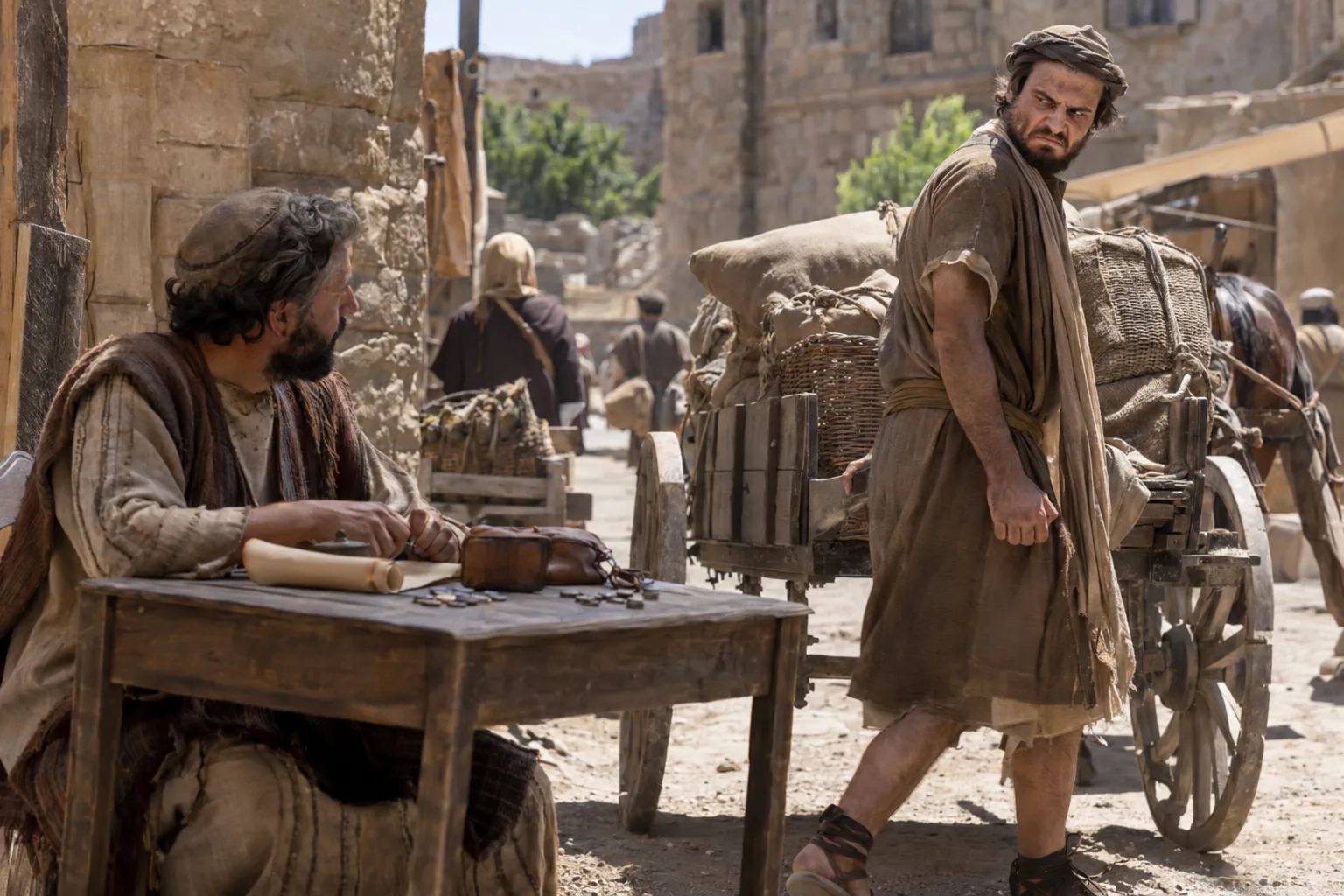
He sits at a table by the roadside where the caravans, the fishermen hauling dried fish to trade, and the farmers with their carts must all pass. Rome wants its revenue, and it is his job to take it: a toll on the load of fish, a customs charge on the bolt of cloth, a fee on the beast and the cart. He knows the official rates, but he also knows how much traffic will bear, and every coin squeezed above what is required is his to keep. One by one, travelers approach, pay, and glare. To them he is a thief with a Roman license, a countryman who serves the occupier and grows fat on his neighbors' backs. He has stopped expecting anyone to look at him kindly.
An Ordinary Afternoon · A Rabbi Stops
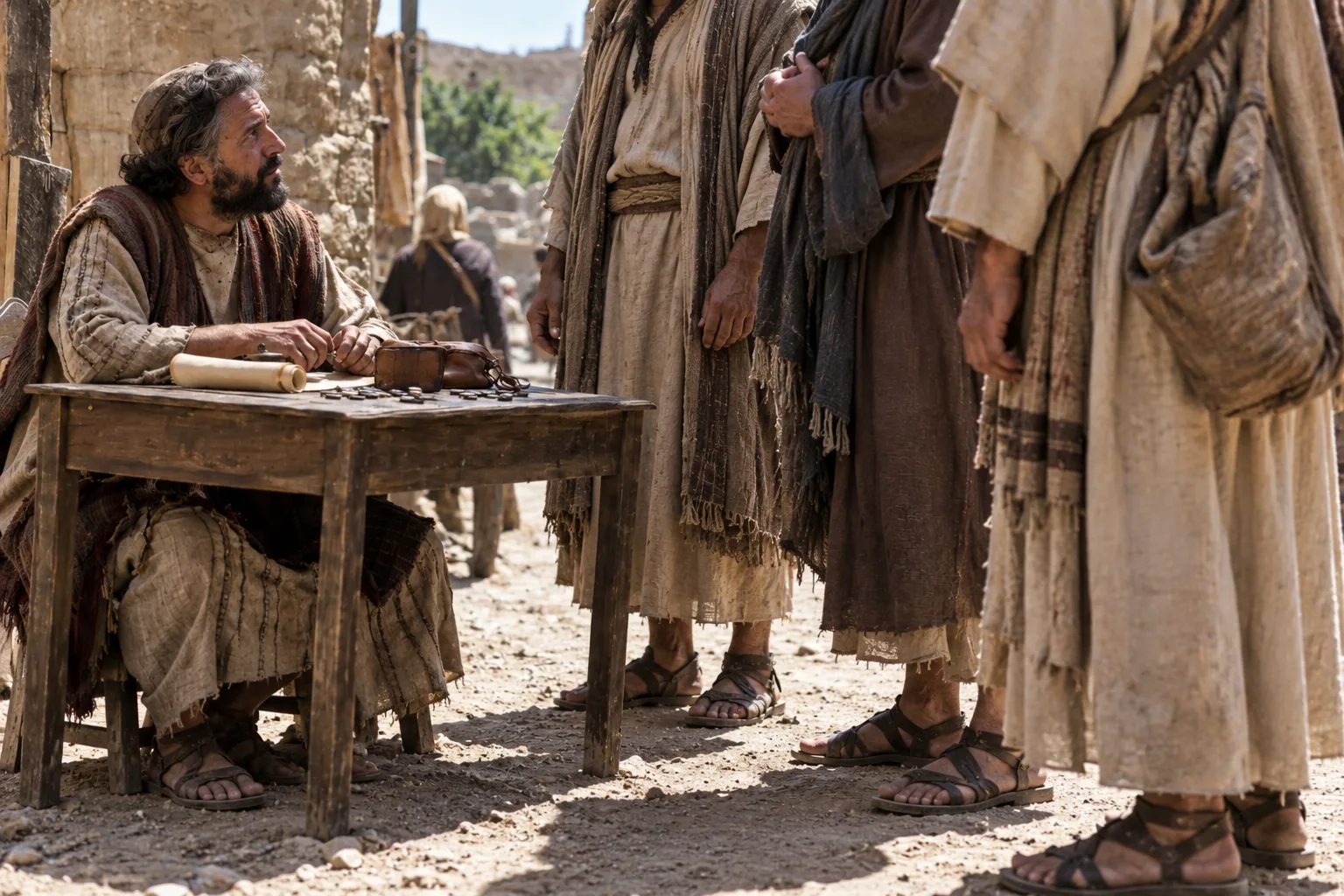
Then one afternoon a rabbi and a crowd of followers come down the road, the kind of teacher who should cross to the other side rather than be seen near a toll booth. Instead, he stops directly in front of the table. The coins are still in a small pile, the ledger still open, mid-transaction. The man looks up, braced for an insult, the way most religious men treat him. Instead he hears two words: "Follow me" (Matthew 9:9). No scolding, no condition, no demand that he fix his life first. Matthew gets up, leaves the money exactly where it sits, and follows.
Jericho, Years Later · Up in the Sycamore
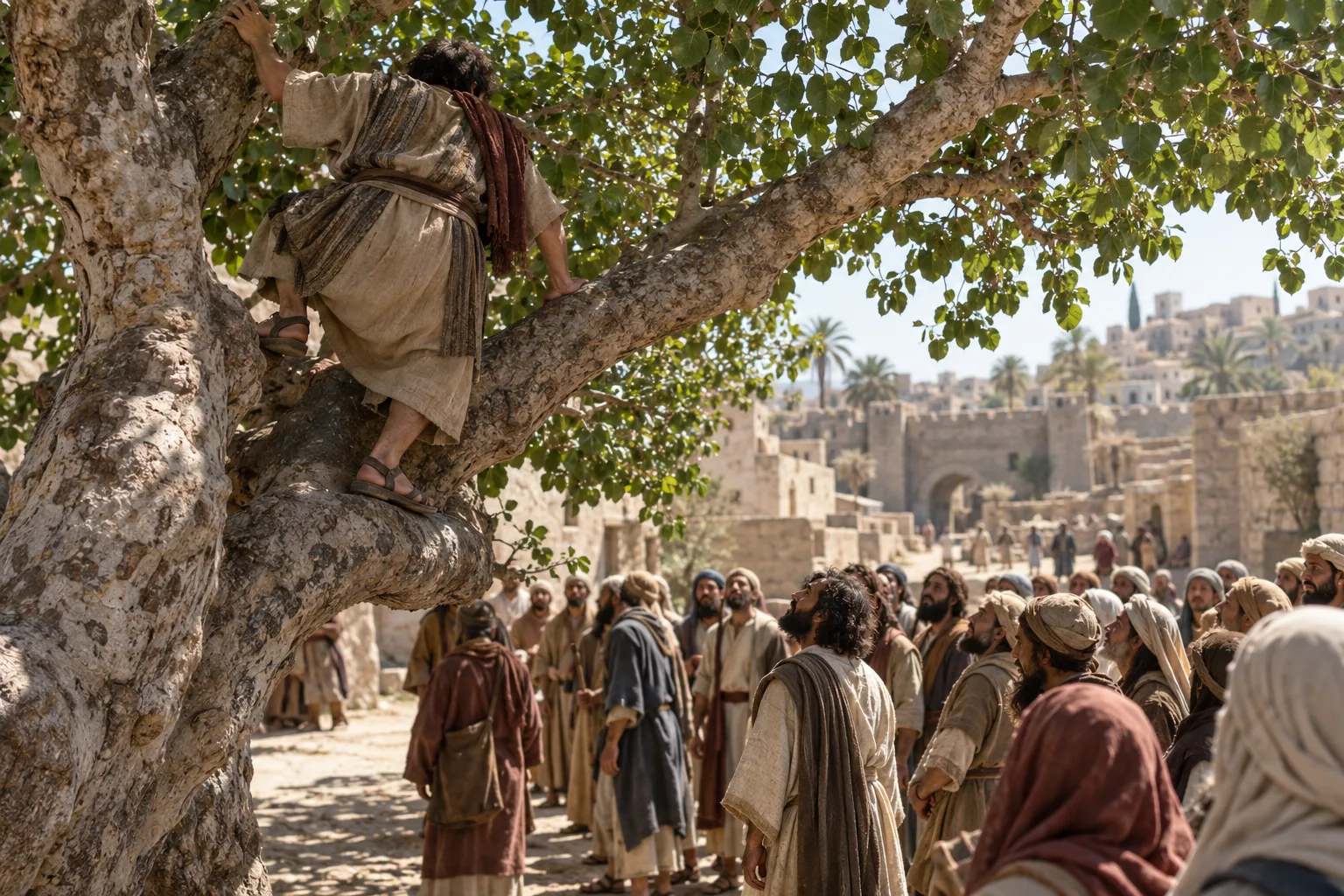
Miles away and years on, in the wealthy trading town of Jericho, another tax collector, a chief collector this time, named Zacchaeus, hears that this same Jesus is passing through. He is rich, powerful enough to oversee other collectors, and too small to see over the crowd lining the road. So he does something beneath his dignity and his wealth: he runs ahead and climbs a sycamore tree like a boy, just to catch a glimpse. When Jesus reaches the spot, He stops, looks up into the branches, and speaks his name: "Zacchaeus, make haste, and come down; for to day I must abide at thy house" (Luke 19:5). Of everyone lining that road, Jesus chooses the house of the man the whole town despises.
At His Table · The Books Come Open
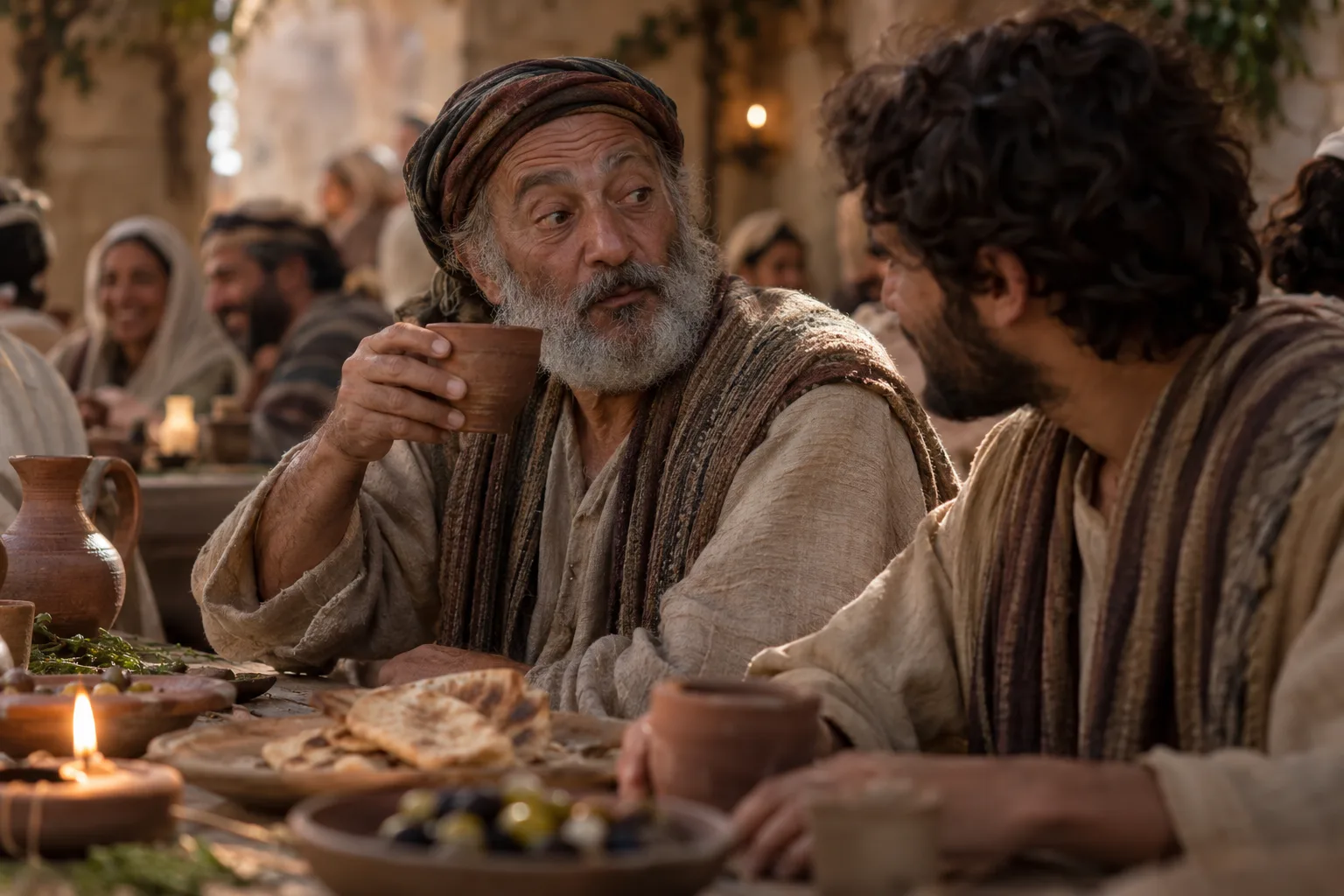
Inside the house, while the crowd outside mutters that Jesus has gone to lodge with a sinner, something breaks open in Zacchaeus. He stands up in front of his guest and says it plainly: half of everything he owns he will give to the poor, and anyone he has cheated through false accusation will receive back four times what was taken (Luke 19:8). This is not a vague feeling of sorrow; it is a rich man's ledgers thrown open and his fortune redirected. Jesus answers with words that reach past Zacchaeus to every outcast listening: "This day is salvation come to this house... for the Son of man is come to seek and to save that which was lost" (Luke 19:9–10).
That contempt at the booth was not unfair on its face. The word the King James Bible translates "publican" (the Greek telones) named exactly this kind of toll and tax collector, and in the Gospels it is paired again and again with "sinners," even with "harlots." A tax collector was assumed to be a cheat and a collaborator, grouped with sinners and treated as an outcast from respectable society.
Now the real questions, the ones the history and the Gospels can answer together.
The Questions You'd Actually Ask
An Honest Q & A
What did a tax collector actually collect?
Mostly tolls and customs on the movement of goods, not a modern income tax. Rome drew revenue in two broad ways: direct taxes on land and persons, and indirect taxes, the tolls, customs, and duties on trade. The men we meet in the Gospels sat at booths on roads, borders, and harbors and taxed what passed by. Matthew was "sitting at the receipt of custom" (Matthew 9:9) in Capernaum, a town on a trade route, when Jesus called him. In Galilee those tolls were gathered for Herod Antipas, Rome's client ruler, rather than for Rome directly. Jericho, where Zacchaeus worked, sat on major routes and rich trade, which helps explain how a chief collector there grew wealthy.
Why were they hated so much?
Two reasons, and both were bitter. First, they were seen as traitors: they collected money for the pagan empire and the client rulers who held the Promised Land, and profited from their own nation's servitude. Second, the system openly invited extortion. A collector paid or answered for a set amount and was largely free to gouge above it, pocketing the excess. That is why "publican" became a byword for greed and dishonesty, and why they were grouped with the worst of sinners. Jesus even used a publican as the picture of the lowest social outcast: treat an unrepentant offender, He said, "as an heathen man and a publican" (Matthew 18:17).
Was the extortion real, or just a stereotype?
It was real enough that John the Baptist addressed it head-on. When tax collectors came to be baptized and asked what they should do, he did not tell them to quit; he told them to stop cheating: "Exact no more than that which is appointed you" (Luke 3:13). The problem was not the existence of the job so much as the routine overcharging built into it. And Zacchaeus's own confession assumes it: he promised to restore fourfold anything he had taken "by false accusation" (Luke 19:8), the language of a man who knew the trade's dishonesty from the inside.
An honest note: exactly how the collection was contracted in first-century Galilee and Judea, who bid, who answered to whom, is reconstructed by historians from scattered evidence and was not identical to the great tax-farming companies of an earlier Roman era. That the trade was widely abused, however, is well attested in both Jewish and Roman sources.
Could a tax collector be part of the religious community?
Barely, though we should be careful how we say it. The Gospels make his low standing unmistakable: he was grouped with "sinners," and respectable people would not share his table. Later Jewish tradition adds sharper detail, that a tax collector was counted defiled, his testimony distrusted, and his place in synagogue life closed off, but some of those specifics come from writings after the New Testament era and are debated by scholars, so we hold them loosely. What the Gospels show plainly is the contempt: it scandalized the Pharisees that Jesus would eat at a tax collector's table, "Why eateth your Master with publicans and sinners?" (Matthew 9:11). To share a meal was to accept a person, and no respectable teacher was supposed to accept these.
Were they all rich?
No. There were levels. A "chief" tax collector, an architelones like Zacchaeus, oversaw others and could indeed grow rich; Luke says plainly Zacchaeus "was rich" (Luke 19:2). But many ordinary booth-collectors were simply local men doing a despised job for a living, neither powerful nor wealthy, just permanently distrusted. What united them was not riches but reputation: whether comfortable or not, they wore the same label of traitor and cheat.
So why did Jesus have anything to do with them?
Because they were exactly the kind of people He came for, and He said so out loud. When the Pharisees grumbled at His eating with publicans and sinners, Jesus answered, "They that be whole need not a physician, but they that are sick... I am not come to call the righteous, but sinners to repentance" (Matthew 9:12–13). He let Himself be called "a friend of publicans and sinners" (Matthew 11:19) as though it were a badge, not an insult. And He told the religious elite that "the publicans and the harlots go into the kingdom of God before you" (Matthew 21:31), because the despised knew they needed mercy, and the respectable did not think they did.
Where It Lands
He Called the Man Everyone Wrote Off
You just watched it happen: the most despised man in town, a collaborator and a cheat, shut out of the synagogue, grouped with harlots, glared at every day. Everyone had written him off. And into that booth walked the Son of God, who did not lecture him or shame him, but said two words that changed everything. Matthew rose, left the money on the table, and became one of the twelve, and the writer of the first Gospel.
Real repentance in Zacchaeus did not stop at an apology. He turned his own wallet into evidence of a changed heart, giving away half of what he owned and repaying everyone he had cheated four times over. That is what happens when grace reaches all the way down to where a person has done the most damage, their money, their relationships, their reputation. Matthew's call and Zacchaeus's repentance say the same thing from two directions: no one is too hated to be called, and no one who is truly called stays unchanged. The same Jesus who said "Follow me" to a man mid-transaction is the one who stood in a sinner's house and pronounced that salvation had arrived there that day. No one is too corrupt, too compromised, or too far gone for Jesus to seek and to save.
For You
Grace That Reaches the Books
Two things press in here. First, the person you have quietly decided is beyond saving, the crooked one, the sellout, the one everyone despises, is exactly the sort Jesus walked up to and called. Do not write off anyone He died for. Pray for them, and be the kind of believer who would sit at their table.
Second, look at what true repentance did to Zacchaeus. It was not only a feeling; it went to his ledgers. It gave money back, made wrongs right, and cared for the poor. If God has met you, let His grace reach all the way into how you handle money, how you treat the people you have wronged, and what you do with what you have. Salvation that never touches the books has not gone very deep.
Carry It With You
Memory Verse
Luke 19:10 KJV
"For the Son of man is come to seek and to save that which was lost."
For the Historical Notes
References & Sources
Scripture is quoted from the KJV. The details of the Roman toll and tax system are drawn from standard scholarship on taxation in the early empire and the Gospels' own portrait of tax collectors. Reconstructed details of the collection system are flagged as such in the study.
- Matthew's call at the booth: Matthew 9:9–13; Mark 2:14–17; Luke 5:27–32.
- Zacchaeus and repentance: Luke 19:1–10.
- The extortion problem and John's answer: Luke 3:12–13.
- "Publican" as a byword: Matthew 5:46; 18:17; 21:31–32.
- Jesus, a friend of the outcast: Matthew 11:19; Luke 15:1–2.
- The Pharisee and the publican: Luke 18:9–14.
Keep Walking Through Their World
More Life & Times studies are being added. Return to the map and pick your next passage.