Listen While You Work
Play this study as you work, drive, or rest. A simple way to keep the Word with you throughout your day, not only as a full sit-down study.
🎧 Listen to this study
Please note: this study is narrated with AI-generated audio, which may occasionally misread a Scripture reference (for example, "Acts 1 point 9" rather than "Acts 1 verse 9"). For the exact wording, please refer to your Bible.
A Day in the Life · The World of the Shepherd
A Day in the Life: A Shepherd
We turn "shepherd" into a gentle, poetic word, but the job itself was hard, lonely, dangerous, and looked down upon. Let us follow a real shepherd through his long day and longer night, and then see the wonder of it: this is the humble work God kept choosing, and to men like this He announced the birth of His Son.
His World at a Glance
He lived outdoors with the flock, moving them to pasture and water through the heat and cold.
Shepherds stayed with the flock through the dark, "keeping watch over their flock by night" (Luke 2:8).
Lions, bears, and wolves threatened the sheep; a good shepherd fought them off, as David did (1 Samuel 17:34–36).
Shepherding was humble, low-status work, yet God kept calling shepherds to great things.
He led rather than drove them, calling "his own sheep by name" (John 10:3–4); they knew his voice.
To shepherds in a field, not to kings, angels first announced the birth of Christ (Luke 2:8–11).
A word before we begin. Shepherding is described all through Scripture, and the basic facts are certain: the outdoor life, the night watches, the predators, the tools, and the low regard the trade often carried. Some claims about just how despised shepherds were in Jesus' day rest partly on later Jewish writings, so we will hold those loosely and lean on what Scripture plainly shows. This study focuses on the shepherd's daily life; for the rich picture of the Good Shepherd and Psalm 23, see our related study, "The Shepherd's World." The Bible is our anchor.
Hard, Lonely, and Never Off Duty
Walk His Day, From Dawn to the Deep Night
Dawn
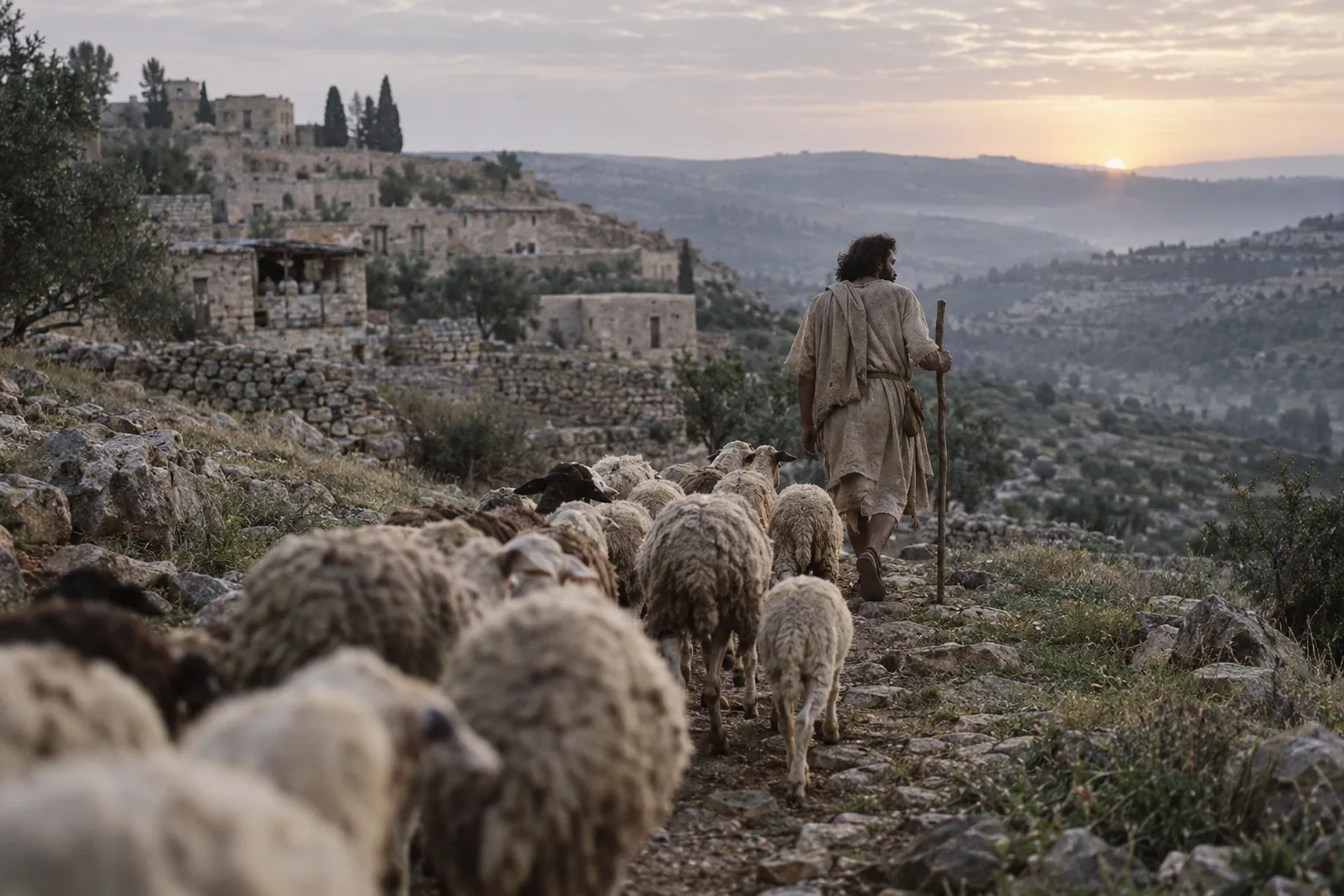
The sky is barely gray when he is already moving. He does not shout or strike the flock to get them up; he simply starts walking, and his own low, familiar voice is enough. One by one the sheep lift their heads and fall in behind him, because every sheep on that hillside already knows the one truth that makes this whole arrangement work: "the sheep follow him: for they know his voice" (John 10:4). There is no fence to check, no gate to open. There is only his voice, leading them out past the last houses of the village and up into hills where the dew has not yet burned off the grass.
He leads, he does not drive. That one detail is the whole difference between a shepherd and a herder of cattle, and it is why Jesus could use this picture so exactly (John 10:3–4).
Midday
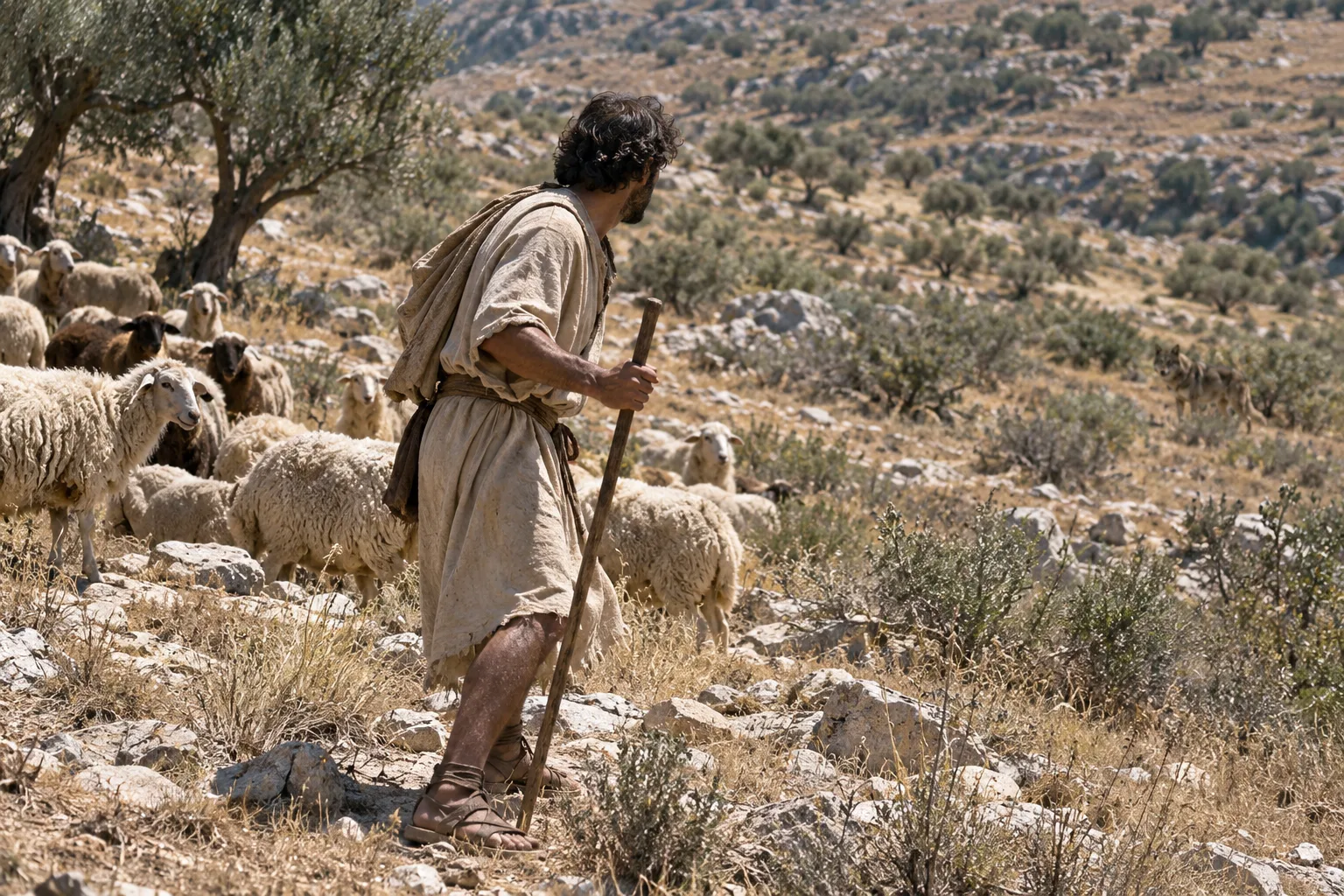
By midday the flock is spread loosely across a slope, and he counts them without seeming to count them, a habit worn so smooth by years that it is almost unconscious, the way a mother counts children crossing a street. Then he sees it: a low movement in the brush below, patient, unhurried, the wrong kind of patient. He does not wait for help, because there is no one else for miles. He takes up his staff and walks straight toward it, because a sheep may already be missing, and there is no version of this job where he does not go after it.
This was not a hypothetical danger. The young David described doing exactly this to King Saul's face: "thy servant kept his father's sheep, and there came a lion, and a bear, and took a lamb out of the flock: and I went out after him, and smote him, and delivered it out of his mouth" (1 Samuel 17:34–35). It is exactly why Jesus drew such a sharp line between a real shepherd and "an hireling," who "seeth the wolf coming, and leaveth the sheep, and fleeth" (John 10:12–13). The measure of a shepherd was whether he stood between the flock and death, or ran.
Dusk
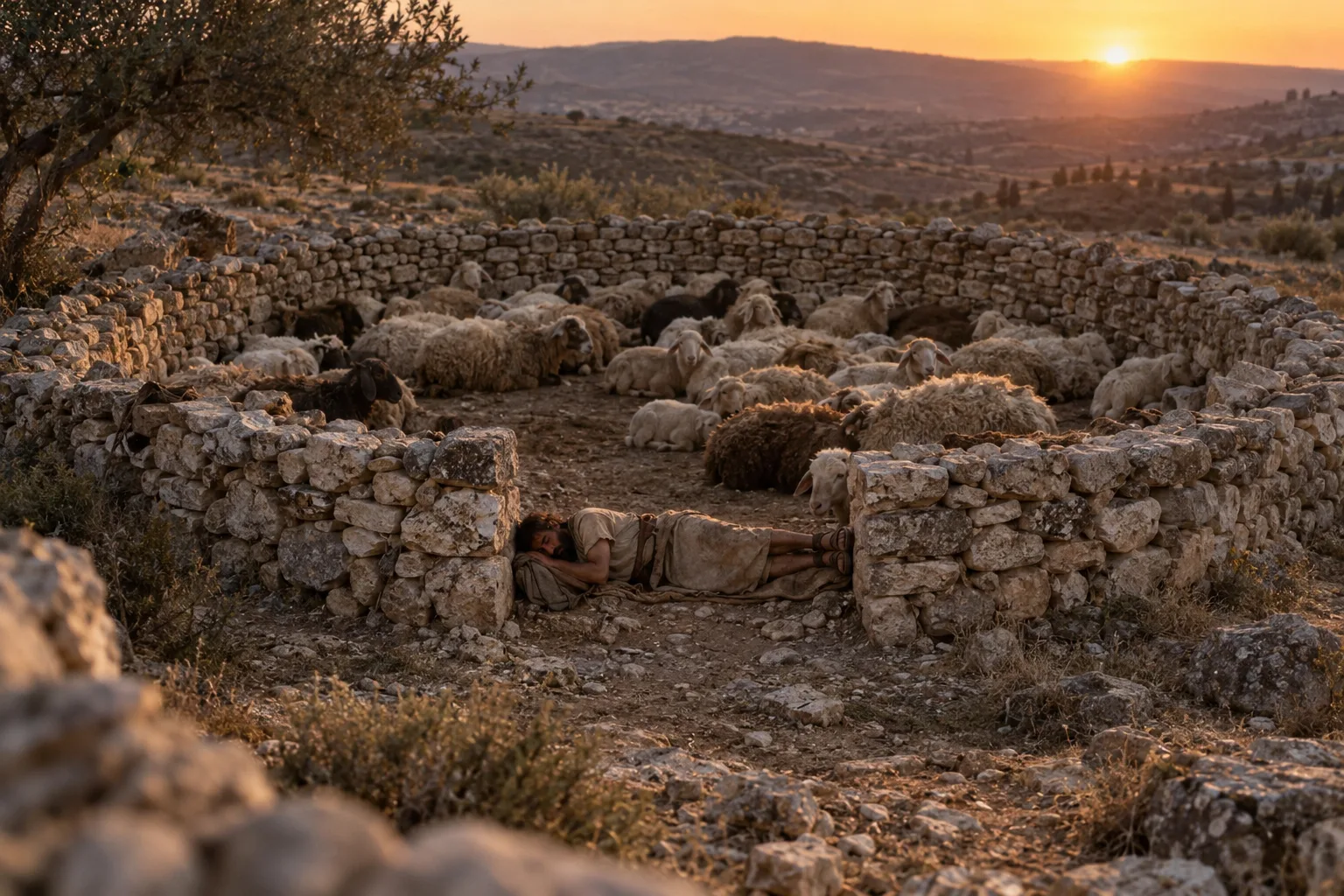
As the light goes gold and then gray, he turns the flock back toward the fold, a rough circle of stacked stone with a single gap left open for a doorway. He counts them through that gap one at a time, Scripture even has a word for this, passing "under the rod" (Leviticus 27:32), each one touched, each one known by hand as well as by name. When the last sheep is inside, there is no door left to shut. So he lies down across the opening himself. Tonight, he is the door.
That practice, a shepherd's own body as the only door a fold needed, is almost certainly what stood behind Jesus' words: "I am the door of the sheep... I am the door: by me if any man enter in, he shall be saved" (John 10:7, 9).
The Deep Night
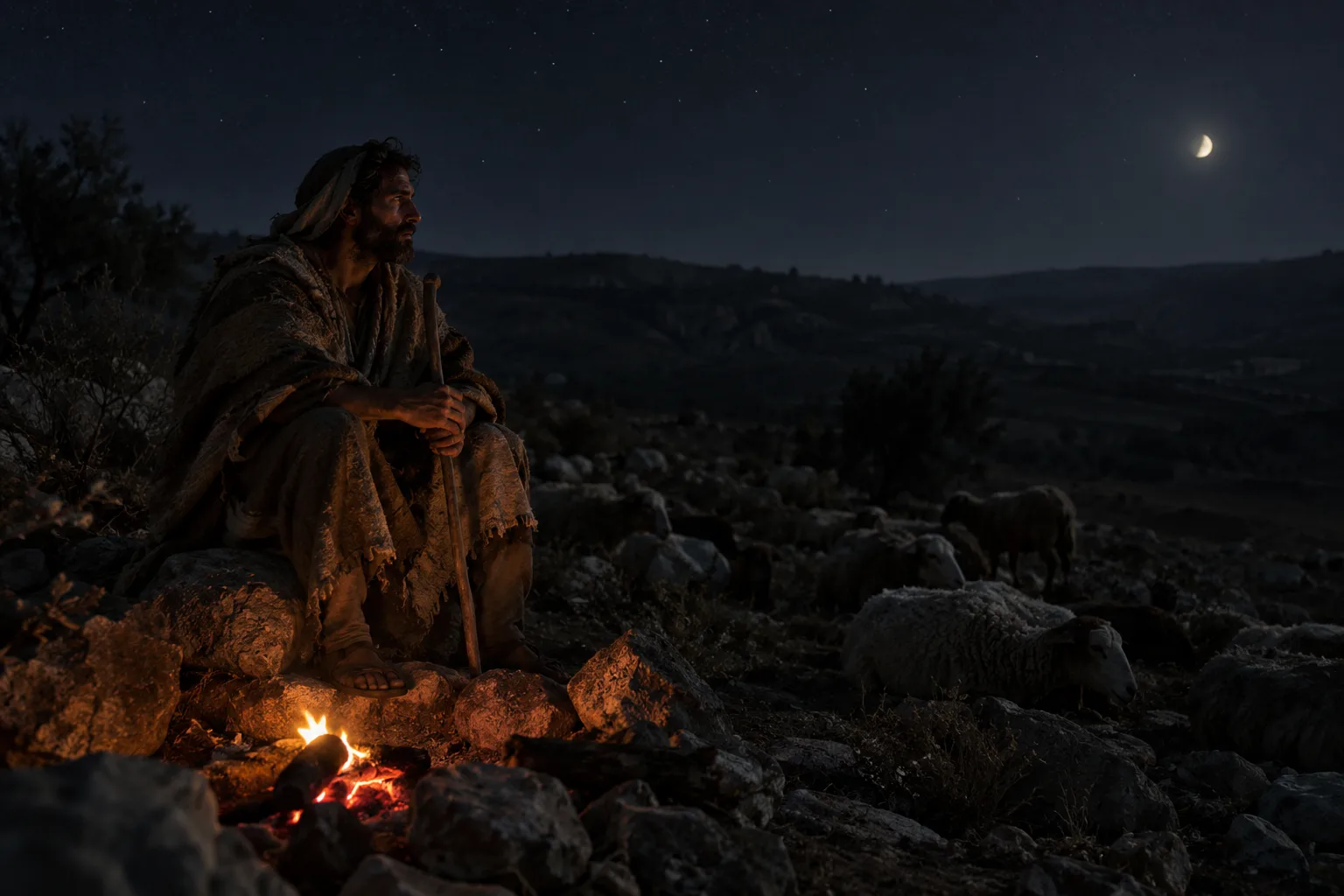
Sleep comes in pieces. The cold reaches his hands first, then his feet, and somewhere past midnight a sound, wind, or a fox, or nothing at all, snaps him fully awake, every single time, because a flock left unwatched for even one unguarded hour might not be there by morning. This is what "keeping watch over their flock by night" (Luke 2:8) actually felt like: not a peaceful vigil under pretty stars, but hour after earned, exhausted hour of real alertness, repeated for years, for no applause and very little pay.
It was a demanding, solitary life, often given to a younger son, a hired hand, or the least of the family. And yet it formed some of the greatest people in the Bible, and it was into a night exactly like the one just described that the sky itself broke open. Hold that thought; it is where this study lands. Now, the real questions.
The Questions You'd Actually Ask
An Honest Q & A
Was that midday danger an everyday thing, or rare?
Common enough that it shaped how people talked about the job. David's story of the lion and the bear was not treated as an unusual tale; it was offered to Saul as ordinary proof that he already knew how to fight for something defenseless. Shepherds also carried real tools for exactly this, a rod, a heavy wooden club for close-range defense, and a sling, the same weapon David later used on Goliath (1 Samuel 17:40, 49–50). A sling was not a toy; a trained shepherd could use one with real, lethal accuracy against both animals and men.
Was shepherding a respected job?
Not really; it was humble, low-status work. Long before, in Egypt, "every shepherd is an abomination unto the Egyptians" (Genesis 46:34), and in Jesus' day the trade was still looked down upon. That is what makes the Bible's pattern so striking: God kept choosing shepherds anyway. He took David "from following the ewes great with young" and made him king (Psalm 78:70–71). Moses kept his father-in-law's flock for forty years before the burning bush (Exodus 3:1). The prophet Amos said, "I was no prophet... but I was an herdman," until God called him (Amos 7:14–15). The lowly job was God's training ground.
An honest note: some of the sharper claims that shepherds were treated as outcasts or barred as witnesses come from later Jewish writings, not the New Testament itself. What Scripture clearly shows is that it was humble, unglamorous work, which only deepens the wonder of how God honored it.
How did a shepherd relate to the sheep?
Personally, and by leading rather than forcing. In that world a shepherd "calleth his own sheep by name, and leadeth them out... and the sheep follow him: for they know his voice" (John 10:3–4). He walked in front; the flock came because they trusted the voice they knew. He counted them, often as they passed "under the rod" (Leviticus 27:32), and he knew each one. When a single sheep wandered off, he went after it, and when he found it, "he layeth it on his shoulders, rejoicing" (Luke 15:5). This close, patient knowing is the whole reason the shepherd became such a rich picture of God's care.
Did the shepherd own the sheep, or work for pay?
Both arrangements existed. Sometimes the shepherd was the owner or a member of the family tending its own flock, as with the patriarchs and young David. Often, though, the work was done by hired hands for wages, and here Jesus drew a sharp line. The hireling works for pay and no more, so "the hireling fleeth, because he is an hireling, and careth not for the sheep" (John 10:13). The owner-shepherd, whose "own the sheep are," stays and fights. The difference was not skill but love: whether the flock was truly his.
Why does the Bible keep coming back to shepherds?
Because the picture fits God Himself. Again and again He calls Himself the Shepherd of His people: "He shall feed his flock like a shepherd: he shall gather the lambs with his arm, and carry them in his bosom" (Isaiah 40:11). The relationship of a faithful shepherd to helpless, wandering, beloved sheep is one of the truest pictures in the world of how God cares for us. And it reaches its climax when the Shepherd Himself comes in the flesh, which is where this humble trade meets the gospel.
Where It Lands
To Shepherds, God Sent the First Word of a Savior
On the night Christ was born, God passed over the palaces and the temple courts and sent His angels to the bottom of the social ladder: "there were in the same country shepherds abiding in the field, keeping watch over their flock by night" (Luke 2:8). To them the angel said, "unto you is born this day in the city of David a Saviour, which is Christ the Lord" (Luke 2:11). The despised got the first invitation. That is how God works, and it is good news for anyone who has ever felt lowly and overlooked.
And the One those shepherds went to see would grow up to say, "I am the good shepherd: the good shepherd giveth his life for the sheep" (John 10:11). Every faithful shepherd who ever risked his life for the flock was a shadow of Him. We are the sheep, prone to wander, helpless against the wolf, and He is the Shepherd who did not flee but laid down His life to save us, and who still "gather[s] the lambs with his arm." He goes after the one that is lost, ourselves, and carries us home rejoicing. And He is one Shepherd over one flock: "there shall be one fold, and one shepherd" (John 10:16). If you have wandered, the Good Shepherd is not hunting you to punish you; He is seeking you to save you. Hear His voice, and follow Him home.
For You
You Are Known, and You Are Sought
Two truths come off the hillside for you. First, if you feel small, hidden, or overlooked, remember whom God keeps choosing and to whom He sent the first Christmas news. Your lowly place is not beneath His notice; it may be exactly where He is preparing you. He is not impressed by thrones and unbothered by your obscurity.
Second, if you have wandered from Him, hear the voice of the Good Shepherd calling you by name. He is not the hireling who flees; He is the Shepherd who gave His life for the sheep and goes after the one that is lost. Stop running, turn, and follow Him home. There is one fold and one Shepherd, and there is room in it for you.
Carry It With You
Memory Verse
Isaiah 40:11 KJV
"He shall feed his flock like a shepherd: he shall gather the lambs with his arm, and carry them in his bosom, and shall gently lead those that are with young."
For the Historical Notes
References & Sources
Scripture is quoted from the KJV. The picture of the shepherd's life is drawn from the biblical text and standard studies of pastoral life in the ancient Near East. Claims resting on later Jewish tradition are flagged as such in the study.
- The work and its dangers: Luke 2:8; 1 Samuel 17:34–36; John 10:11–13.
- Leading and knowing the flock: John 10:3–5; Leviticus 27:32; Luke 15:3–6.
- The lowly trade God chose: Genesis 46:34; Exodus 3:1; Psalm 78:70–72; Amos 7:14–15.
- God the Shepherd, and the birth announced to shepherds: Isaiah 40:11; Psalm 23; Luke 2:8–20.
- The Good Shepherd and His flock: John 10:1–18; 1 Peter 5:2–4.
Keep Walking Through Their World
More Life & Times studies are being added. Return to the map and pick your next passage.