Listen While You Work
Play this study as you work, drive, or rest. A simple way to keep the Word with you throughout your day, not only as a full sit-down study.
🎧 Listen to this study
Please note: this study is narrated with AI-generated audio, which may occasionally misread a Scripture reference (for example, "Acts 1 point 9" rather than "Acts 1 verse 9"). For the exact wording, please refer to your Bible.
A Day in the Life · The New Testament World
A Day in the Life: A Galilee Fisherman
Let us follow an ordinary fisherman on the Sea of Galilee, a man like Peter or Andrew, from the end of his night's work through the middle of the day. Not a hero, not a scene from a sermon, just a real working life, so you can feel the world Jesus stepped into and the men He called.
His World at a Glance
The best fishing was after dark, so his "day" often ran through the night and ended at dawn.
A devout man prayed morning, noon, and evening, and recited the Shema (Deuteronomy 6:4).
Bread was the staple, with olives, dried or salted fish, cheese, and watered wine.
Extended families shared a home or courtyard; work, home, and synagogue were all near.
Fish were sold fresh at market or handed to salting works; the towns lived off the lake.
The weekly Sabbath and the yearly feasts built rest and celebration into life.
A word before we begin. No one left us a fisherman's diary, so this is careful reconstruction, not a transcript. The big pieces are well documented, night fishing, the Sabbath and feasts, the food, the taxes, walking and donkeys, marriage customs. The small domestic details, a kiss at the door, the exact order of a morning, we fill in gently from many sources, and we will tell you plainly which is which. Where we simply do not know, we will say so.
Morning to Noon
The End of the Night, the Start of the Day
Hours Before Dawn
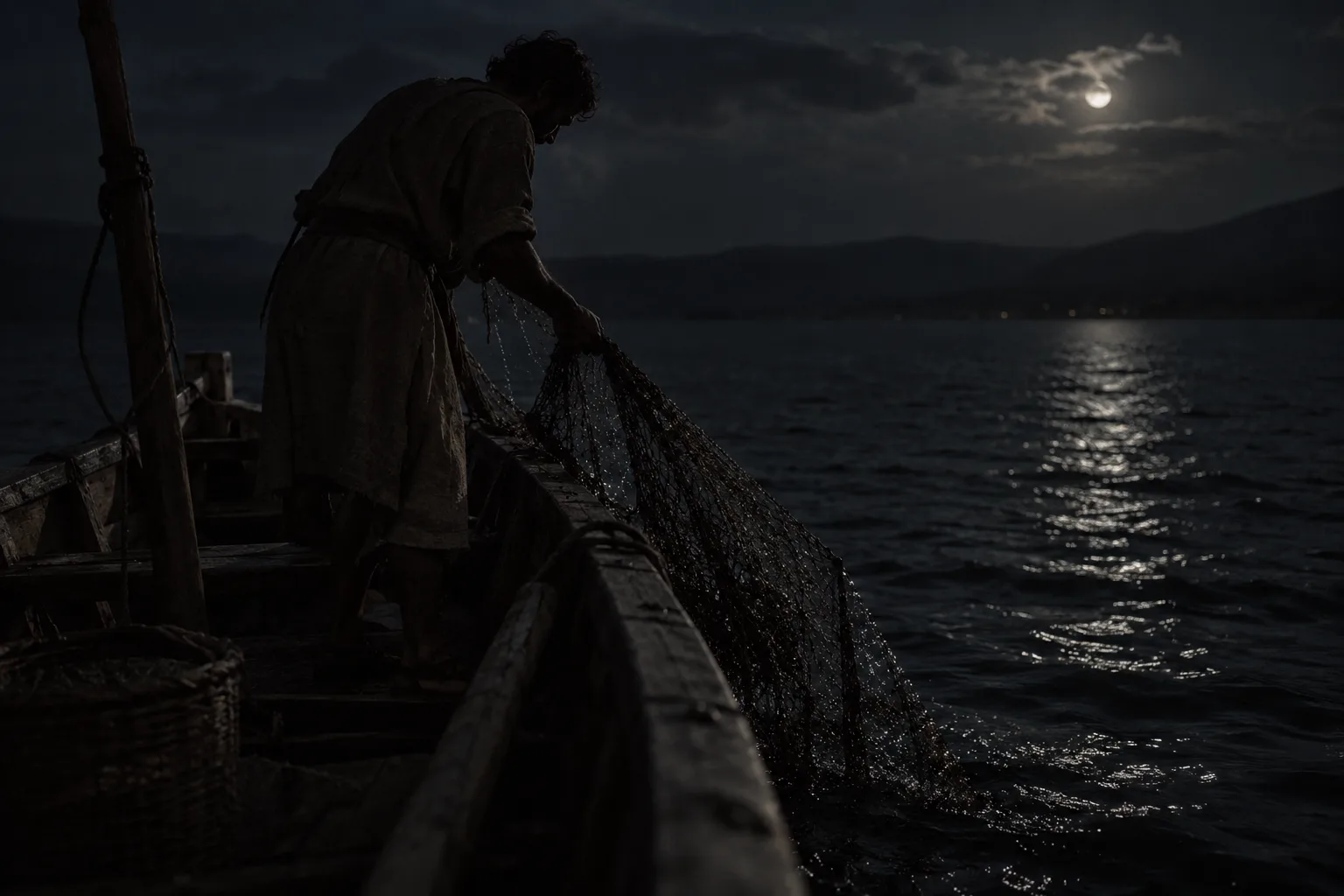
The lake is black and silent except for the dip of the oars and the soft slap of water against the hull. He has lost count of how many times tonight they have let down the net and hauled it back up again, dripping and empty; the muscles in his forearms burn, and the night air is cold enough to see his breath. This is the work no one sees from shore, the failed casts, the net coming up heavy with nothing but weeds and moonlight. A man who has fished these waters his whole life knows this exact frustration: "Master, we have toiled all the night, and have taken nothing" (Luke 5:5), the very words some of these fishermen would one day say to a rabbi standing in their boat. Tonight there is no rabbi, only exhaustion and the stubborn decision to try one more cast before the sky turns gray.
First Light on the Shingle
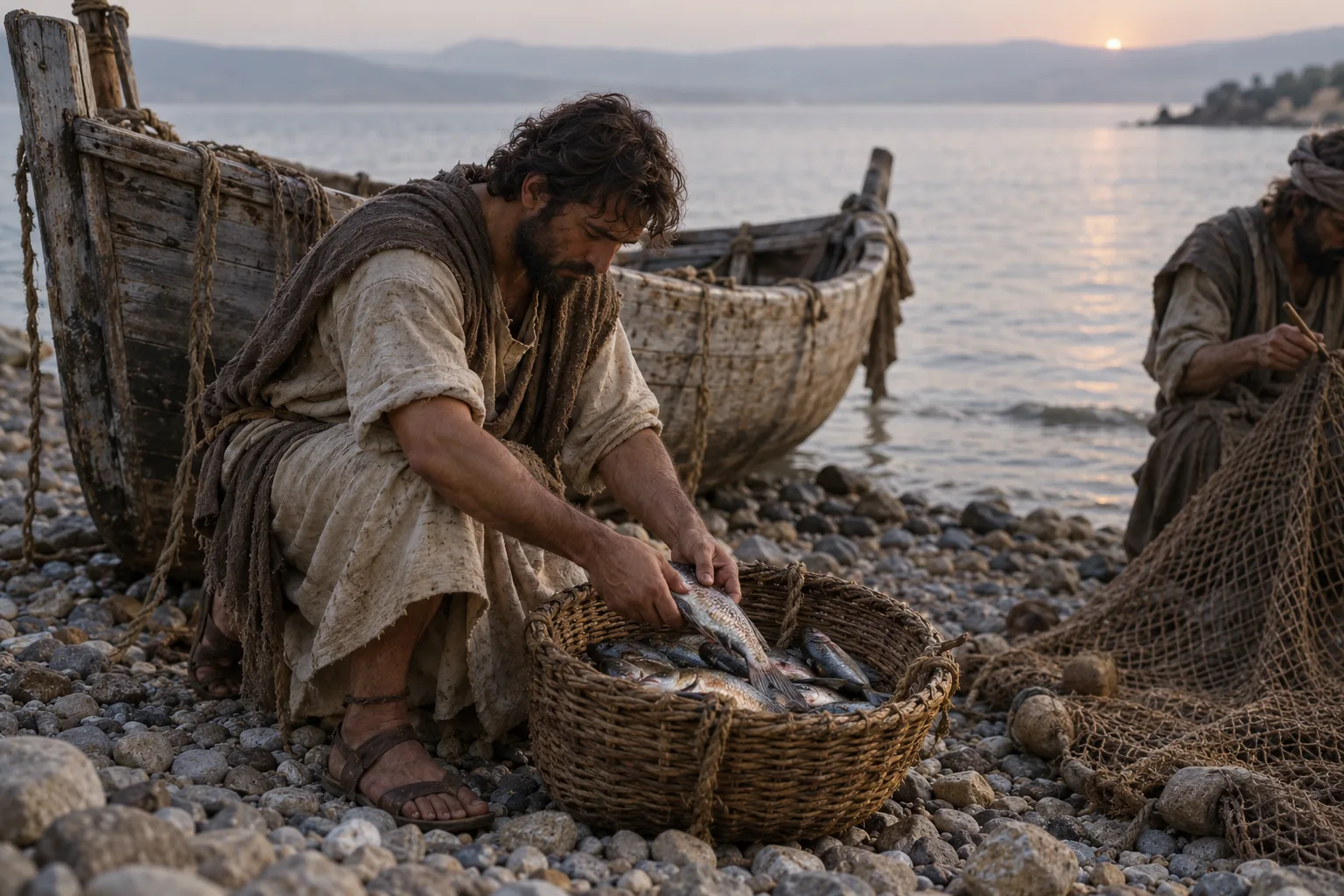
As the sky pales, they row for shore and drag the boat up onto the pebbled beach. Now comes the sorting: good fish tossed into woven baskets, worthless or unclean creatures thrown back into the shallows. Then the slow, tedious work begins, the net spread out across the stones, fingers working through tear after tear, pulling weeds and bits of reed from the mesh. It is unglamorous, repetitive labor, the kind the Gospels mention almost in passing, James and John "in the ship mending their nets" (Mark 1:19) when Jesus called them too. Tomorrow night depends on getting it right today.
To Market, Before It Spoils
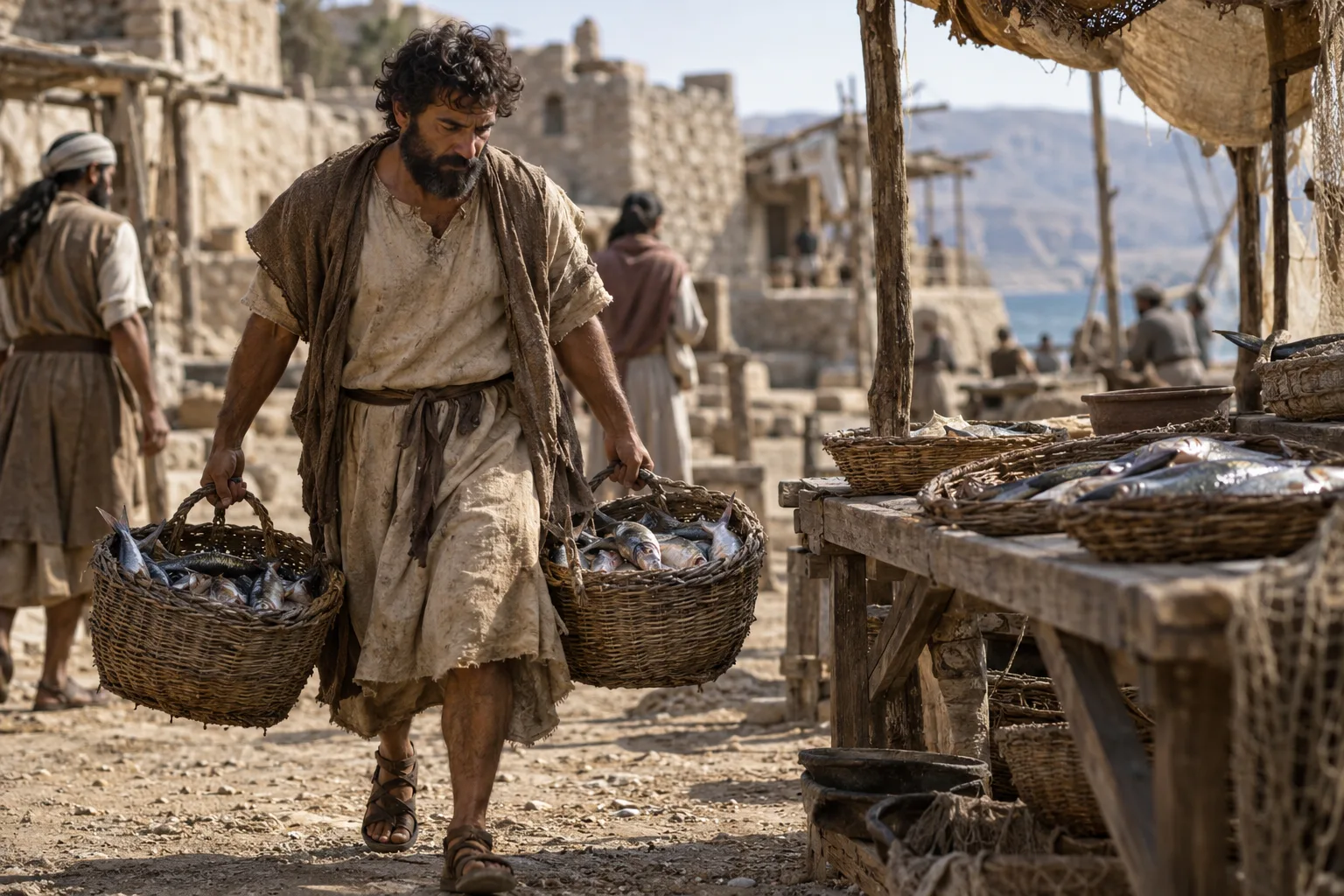
There is no time to rest yet. Fish spoil fast in the Galilean heat, so the morning's catch is carried, or walked by donkey if the family owns one, straight to the market stalls or the salting works where it can be preserved for trade farther away. He haggles briefly over the price, hands over whatever toll applies, and pockets the rest. This is the day's wage, earned and spent before most of the town is even awake.
Midday, Bread and Rest
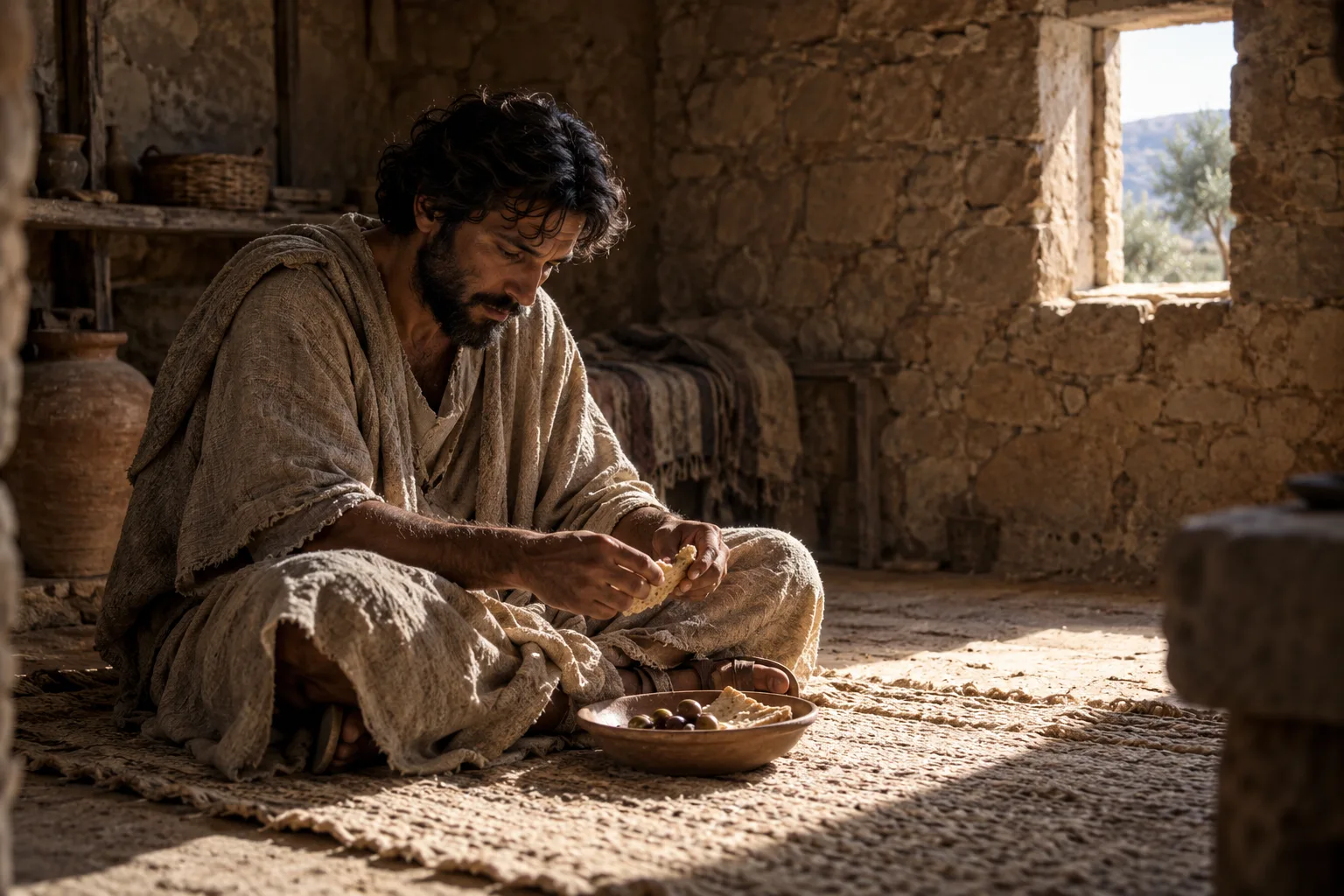
Only now does he turn toward home. He washes the smell of the lake from his hands and arms, and somewhere in the small, crowded house he stops to pray, lifting the ancient words to God as a faithful man does morning, noon, and evening: "Evening, and morning, and at noon, will I pray, and cry aloud: and he shall hear my voice" (Psalm 55:17). A simple meal follows, bread torn by hand, a few olives, a piece of dried fish. Then, while the sun stands high and the heat presses down on the town, he finally sleeps. His noon is our midnight; by the time the next night's work begins, he will need every hour of this stolen rest.
That is the rhythm. Now the real questions, the ones you would actually want to ask a man like this.
The Questions You'd Actually Ask
An Honest Q & A
Was there ever time to just play or rest?
Yes, but not the way we think of free time. Rest was built into the calendar by God. Every seventh day was the Sabbath, a full day when no work was done, unheard of in the surrounding world (Exodus 20:8–10). On top of that came the yearly feasts, Passover, Pentecost, Tabernacles and more, which were joyful holidays of feasting and, for the pilgrim feasts, travel to Jerusalem. Daily life also had its social pauses: shared meals, the well, and the city gate where men gathered to talk and hear the news. And children certainly played, "the streets of the city shall be full of boys and girls playing" (Zechariah 8:5); Jesus even pictured children playing wedding and funeral in the market (Matthew 11:16–17). So there was music, laughter, and rest, mostly woven into the Sabbath, the feasts, and the table, rather than into idle afternoons.
Did he just get up, get a kiss, grab bread, and go?
Close, with one addition. Ordinary people rose and slept with the sun, and bread was the portable staple you took with you. Warm family affection was normal. But a devout Jew did not simply bolt out the door; he prayed. He would recite the Shema, "Hear, O Israel: The LORD our God is one LORD" (Deuteronomy 6:4), and lift up morning prayer to God. Faith was not a Sabbath add-on; it framed the start of the day. (The exact household routine, who kissed whom, is the part we are gently imagining.)
What about an unmarried fisherman? Was it bad not to marry?
Marriage was the strong and honored norm. From the beginning God said, "It is not good that the man should be alone" (Genesis 2:18), children were counted a blessing (Psalm 127–128), and most men married young. An adult man who never married was unusual, and could be looked on with some pity, though it was never called sin. Many unmarried men simply lived within the larger family household. And importantly, Scripture also honors singleness given to God: Jesus spoke of those who stay single "for the kingdom of heaven's sake" (Matthew 19:12), and Paul commended the freedom of the unmarried to serve the Lord without distraction (1 Corinthians 7:32–35). So marriage was expected and celebrated, and faithful singleness was honorable too.
How did he pay his bills? Was there a one-stop shop?
There was no supermarket. Instead there was the market, a cluster of specialized sellers and stalls, plus traveling merchants and the craftsmen's shops, the baker, the potter, the smith. And a great deal was simply made at home rather than bought; bread was baked, clothes were spun and sewn. A fisherman earned his living by selling his catch, fresh at market or to the fish-salters, and used that to buy what he could not make: oil, salt, tools, cloth, a new net.
Were there bills besides taxes, like rent?
Taxes were the heaviest burden, and they came in layers: the Roman tribute, tolls and customs on trade and goods (a tax collector like Matthew sat at a booth doing exactly this), the temple tax of a half-shekel, and the tithes owed to God. Beyond taxes there were real costs of living. Some families owned their home; many were tenants who paid rent, often a share of produce, to a wealthy landlord, the world behind Jesus' parables of tenants. Add the price of goods you could not make, repairs to boats and nets, and giving to the poor and the synagogue, and a working man's earnings were spoken for quickly.
One honest uncertainty: historians debate exactly how the Galilee fishery was taxed, whether fishermen leased fishing rights or paid a set portion of the catch to the ruler's agents. That the trade was taxed is clear; the precise arrangement is reconstructed, not certain.
Did they have parties besides weddings?
Yes, and often. Every week the Sabbath began with a family meal. Every year the feasts brought celebration, especially the pilgrim festivals in Jerusalem. Families marked milestones with feasting: a baby's naming, and a great feast when a child was weaned (Genesis 21:8). Harvest brought its own joy. And homecomings could turn into real parties, when the prodigal returned, there was "musick and dancing" (Luke 15:25). Lavish birthday banquets were mostly a thing of royalty (Herod's, Matthew 14:6), not the common folk, but ordinary people knew how to gather, eat, sing, and rejoice.
Did they walk everywhere, or have a horse?
They walked. Ordinary people traveled the roads on foot, as Jesus and His disciples did constantly. Horses were not everyday transport; they belonged to kings, soldiers, and the wealthy, symbols of war and power ("some trust in chariots, and some in horses," Psalm 20:7). The common working animal was the humble donkey, the poor man's mount and pack-carrier, which is why it meant so much that the King came "lowly, and riding upon an ass" (Zechariah 9:9). A fisherman would walk to market, and use a donkey, if he had one, to carry his fish. Camels were for long-distance desert trade, not a trip into town.
Where It Lands
Into This Ordinary Life, God Came
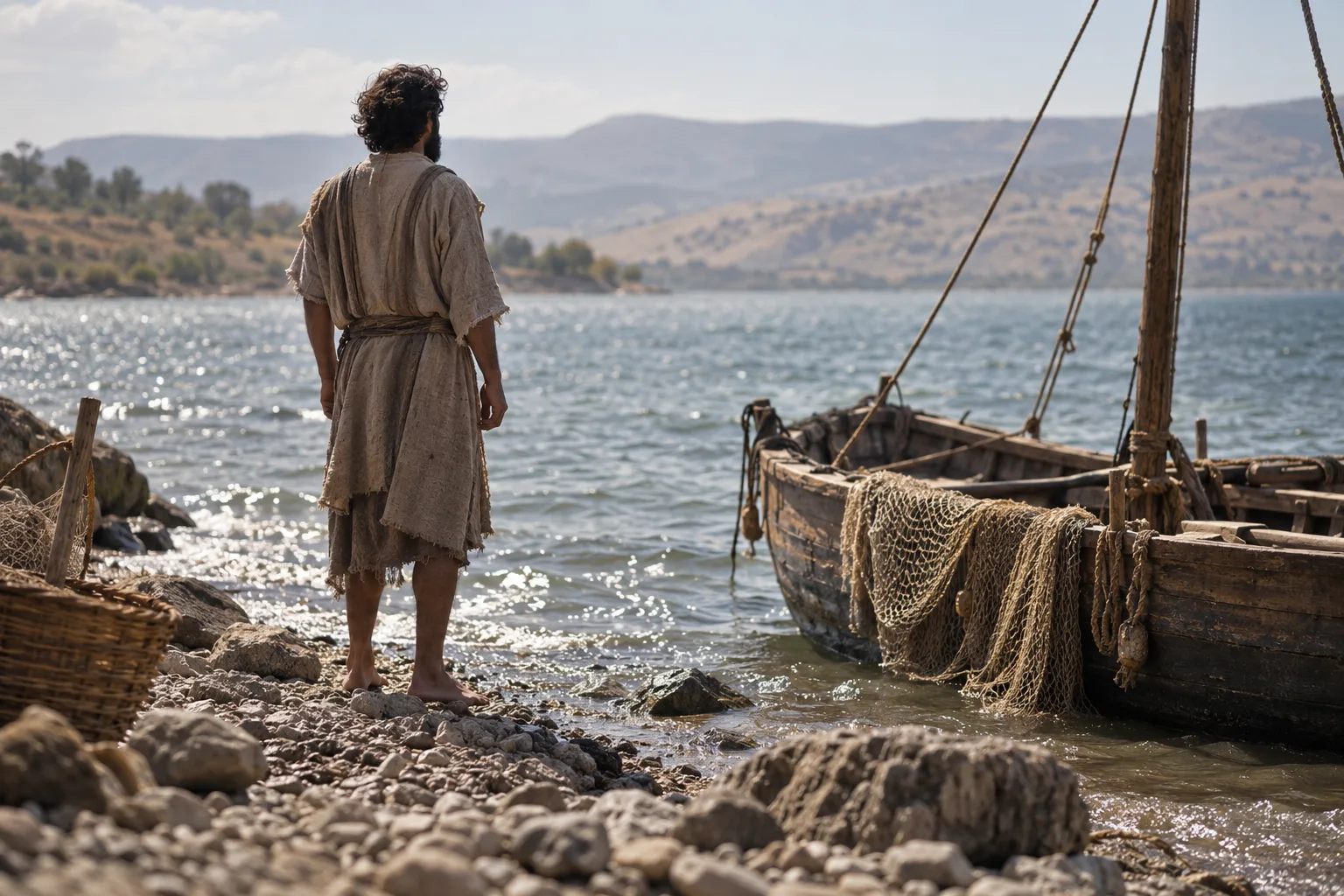
Sit with how plain it all was. Long nights of hard labor. Aching hands mending nets. Simple bread. Layers of taxes. Walking everywhere. Rest measured out in Sabbaths and feasts. This was not a special or spiritual world; it was tired, taxed, and utterly ordinary. And it was into exactly this world that the Son of God came, and it was men just like this, working fishermen with fish-smelling hands, that He walked up to and called.
Jesus did not recruit from the palaces or the schools. He came to the shore at the end of a long, empty night and said to bone-tired fishermen, "Follow me, and I will make you fishers of men" (Matthew 4:19). God in the flesh entered the ordinary day, the work, the meals, the taxes, the walking, and He filled it with Himself. That means your ordinary Tuesday is not beneath God's notice; it is the very place He meets working people and makes them His own. He is not only Lord of the temple and the feast. He is Lord of the boat, the market, and the mended net.
For You
Your Ordinary Day Is Holy Ground
It is easy to think God shows up only in church services and mountaintop moments. But the men who turned the world upside down were first found doing their jobs, tired, taxed, and unremarkable. God met them in the middle of an ordinary working day and made their whole lives count.
So do your work, whatever it is, as unto Him. Rest when He gives you rest. Gather, feast, and rejoice with your people. And keep your heart open in the middle of the ordinary, because that is exactly where He still walks up to ordinary people and calls them by name.
Carry It With You
Memory Verse
Colossians 3:23 KJV
"And whatsoever ye do, do it heartily, as to the Lord, and not unto men."
For the Historical Notes
References & Sources
Scripture is quoted from the KJV. This portrait is drawn from the biblical text and standard studies of daily life in first-century Galilee. Reconstructed details are flagged as such in the study.
- Fishing and its rhythm: Luke 5:1–11; John 21:1–8; Matthew 4:18–22.
- Prayer and the Shema: Deuteronomy 6:4–9; Psalm 55:17; Daniel 6:10.
- Sabbath, feasts, and rest: Exodus 20:8–11; Leviticus 23; Zechariah 8:5.
- Marriage and singleness: Genesis 2:18; Matthew 19:10–12; 1 Corinthians 7:32–35.
- Taxes, trade, and tenancy: Matthew 9:9; 17:24–27; 22:17–21; 21:33–41.
- Feasting and travel: Genesis 21:8; Luke 15:22–25; and walking and the donkey, Zechariah 9:9; Psalm 20:7.
Keep Walking Through Their World
More Life & Times studies are being added. Return to the map and pick your next passage.