Step 5 of 15
1.4 New Birth and Life In Christ
Lesson 1: Created With Purpose
Section Reading
This section focuses on the new birth and life in Christ. What you learned in the previous sections revealed God’s design and purpose for humanity at creation. The following Scriptures speak specifically to those who have been born again. Through salvation, a person enters into a new life in Christ. Salvation does not merely restore what was broken; it begins a spiritual transformation in which God renews, redeems, and reshapes a person by His Spirit. The Word of God makes this truth clear:
2 Corinthians 3:18 says, “But we all, with unveiled face, beholding as in a mirror the glory of the Lord, are being transformed into the same image from glory to glory, just as by the Spirit of the Lord.”
This passage speaks specifically to believers under the new covenant; it is not a general statement about human identity. Those who are born again experience the removal of the veil and are transformed “from glory to glory” by the Spirit. Salvation removes the veil and brings a person into a transforming work of becoming more like Christ.
Romans 8:29 declares, “For whom He foreknew, He also predestined to be conformed to the image of His Son, that He might be the firstborn among many brethren.” This verse speaks to the work God accomplishes in those who are born again, shaping them into the likeness of His Son. We are created in God’s image, and through the new birth we are conformed into the image of Christ by the Spirit.
This transformation becomes possible through the new birth, which Scripture describes as repentance (death), baptism in Jesus’ Name (burial), and the infilling of the Holy Spirit (resurrection and new life). As a result, you are no longer ruled by sin or defined by its power, though you still wage war against the flesh as the Spirit enables obedience and growth.
Ephesians 2:10 highlights the transformation that occurs through new life in Christ, “For we are His workmanship, created in Christ Jesus for good works, which God prepared beforehand that we should walk in them.” Notice the phrase “created in Christ Jesus.” This does not refer to the original creation of humanity in Genesis; rather, it describes the new life that begins the moment a person is born again. Through salvation, God does not simply repair what was broken; He begins a new work in you through His Spirit, who brings resurrection life after baptism.
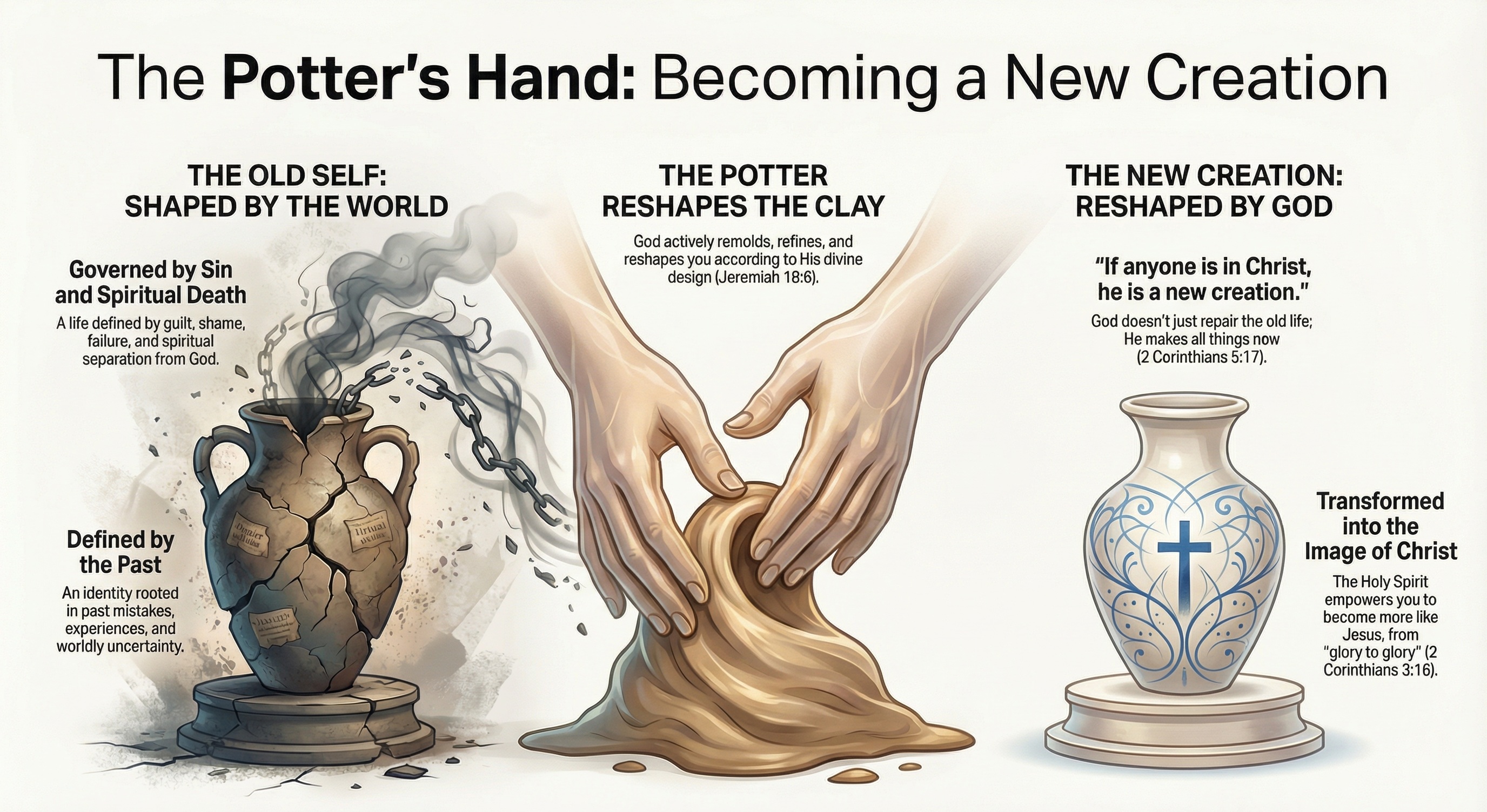
Through salvation, a person is made spiritually alive in Christ. What was once governed by sin and spiritual death is now governed by the Spirit. The believer is forgiven, washed, justified, and sanctified, and is brought into a restored relationship with God as Father. Though the flesh must still be disciplined, the Holy Spirit empowers obedience and enables a new way of living that was not possible before the new birth.
The Bible emphasizes the totality of this transformation. In 2 Corinthians 5:17 it states, “Therefore, if anyone is in Christ, he is a new creation; old things have passed away; behold, all things have become new.” This new creation in Christ is not merely symbolic or theoretical; it is real and transformative. The former life marked by guilt, shame, sin, failure, and spiritual death has been left behind. In its place, a new life characterized by righteousness, spiritual life, and divine calling begins through Christ.
God created you as His work of art, and through salvation He shapes your life as His child. When you surrender your life to Jesus, He begins the work of redeeming your past pain, reshaping your story, and forming a testimony of His grace. The life of a believer is not defined by past mistakes but by the finished work of Jesus Christ.
The same hands that formed you in Genesis now reshape you through redemption. Jeremiah 18:6 says, “O house of Israel, can I not do with you as this potter?” says the LORD. “Look, as the clay is in the potter’s hand, so are you in My hand.” Through salvation, God does not merely touch the clay; He remolds, refines, and reshapes it according to His divine design.
Isaiah 64:8 declares, “But now, O LORD, You are our Father; we are the clay, and You our potter; and all we are the work of Your hand.” God is revealed as Creator, and through salvation He is known relationally as Father. This shift changes everything. Before salvation, God is known primarily as Creator. Through salvation, He is revealed relationally as Father to those who are born again. This relationship becomes the foundation for spiritual growth and transformation.
Through salvation, you enter into the life God always intended for you. You are no longer defined by your past experiences but by what Jesus has done for you. Instead of being shaped by the world, you are now molded by the Spirit. You are no longer bound by sin; rather, you are empowered by grace. Your life is no longer rooted in uncertainty, but in Christ, who now defines your purpose and direction.
Did you know?
The new birth marks one of the most profound changes a person can experience. Scripture refers to this work as regeneration. Titus 3:5 states that God saves us through “the washing of regeneration and renewing of the Holy Spirit.” This spiritual renewal is accomplished by the Holy Spirit and is associated in Scripture with repentance, baptism in the name of Jesus Christ, and the receiving of the Holy Spirit. Through the new birth, God performs an inward work that reshapes how a person thinks, chooses, and lives.
Research in behavioral and cognitive science observes that deeply held beliefs and life-directing commitments influence emotional regulation, decision-making, and long-term behavior. Studies on spiritual conversion and disciplined religious practice indicate that individuals who engage in prayer, Bible reading, confession, and consistent obedience often experience greater clarity of purpose, emotional stability, and resilience over time.
The Bible teaches this transformation as the work of the Spirit. Passages such as 2 Corinthians 3:18, Romans 8:29, Ephesians 2:10, and 2 Corinthians 5:17 reveal that those who are born again are renewed inwardly and shaped into the likeness of Christ. This change is not superficial or temporary. It affects the mind, the heart, and daily conduct.
While science can observe the effects of this change, Scripture explains its source. The renewing of the inner person comes through the Holy Spirit, who works within the believer to conform their life to the will of God. This reflects a powerful truth taught throughout Scripture: through the new birth, Jesus does not merely forgive past sins but produces a real, ongoing transformation in the life of the believer.
John's Story
The following story is not an assignment. It is a real testimony that shows how these truths can look in a real person’s life.

John did not come to faith because life was going well. He came because he was exhausted. For years, he carried the weight of old mistakes, fractured relationships, and habits he could never fully escape. Outwardly, he kept moving forward. Inwardly, he felt hollow. Shame surfaced in quiet moments, and guilt followed whenever he slowed down. No matter how much effort he put into changing, his past always seemed louder than his intentions.
John tried to do better. He tried to be disciplined. He tried to leave certain things behind. But the harder he worked, the more he realized that effort alone could not undo what had already shaped him. Late at night, he found himself thinking about God, wondering if forgiveness was possible or if too much damage had already been done.
When John finally began seeking Jesus seriously, something shifted within him. He became deeply aware of his sin, his need for mercy, and his inability to fix himself. For the first time, he stopped trying to justify his past or manage his guilt. He began to repent, not just feeling sorry, but turning away from the old ways of thinking and living. He sensed that God was calling him to leave his former life behind, even though he did not yet understand what that fully meant.
As John read Scripture and spent time in prayer, he encountered a truth that unsettled and comforted him at the same time. Salvation was not merely believing better or trying harder. It was God offering new life through obedience to His plan. John began to understand that forgiveness, cleansing, and transformation were not symbolic ideas, but realities God intended to give through repentance, baptism, and the work of the Holy Spirit. This realization raised new questions and stirred a hunger to know more.
At times, John felt confused. Old habits still tried to resurface. Familiar fears returned. He wondered whether these struggles meant he had failed or misunderstood what it meant to follow Christ. Slowly, through Scripture, he learned that conviction did not mean rejection. It meant God was drawing him forward. The old life was losing its grip, even though it had not fully released him yet.
John was introduced to believers who began studying the Bible with him. They did not pressure him or rush him, but patiently walked through Scripture, showing him what Jesus taught about salvation, obedience, and new life. Through these studies, John began to see how repentance leads to baptism in Jesus’ Name and how receiving the Holy Spirit brings resurrection life and power to walk differently. What once felt confusing started to come into focus.
John realized that God was not asking him to clean himself up before coming closer. God was inviting him into a process that would change everything. His past no longer defined where he was going. His questions did not disqualify him. They were evidence that God was at work, preparing his heart for what was ahead.
John’s story did not end with understanding alone. It moved forward with expectation. He knew that true new life was not something he could create on his own, but something God would give as he continued learning, obeying, and responding to truth. As John walked forward, he began to understand that salvation was not a moment to rush past, but a covenant to enter fully.
Optional Reflection
This reflection is completely optional. Your responses are not submitted, shared, or saved anywhere. They are for your personal reflection or group discussion only. If you choose to write responses, you may print or save them for yourself.
In this section, you read John’s story. While your journey may not look exactly like his, many people can relate to carrying guilt, shame, or exhaustion from past choices, habits, or seasons of life. John’s story reflects what it can look like to become aware of the need for salvation and to begin turning toward the new life God offers through Jesus Christ.
As you continue through this course, you will learn more about what Scripture teaches regarding salvation, the new birth, and how new life in Christ is entered through repentance, baptism in Jesus’ Name, and receiving the Holy Spirit. Lessons later in this course will explore these truths more deeply.
When you are ready, continue to the learner response page and follow the guidance of your pastor or church leader. Your reflections may be used for personal study, group discussion, or submitted as part of a church dicipleship course, as directed.
📝 My Notes
Log in or create a free account to take private notes and highlight passages.