Step 4 of 15
1.3 Will You Trust The Potter?
Lesson 1: Created With Purpose
Section Reading
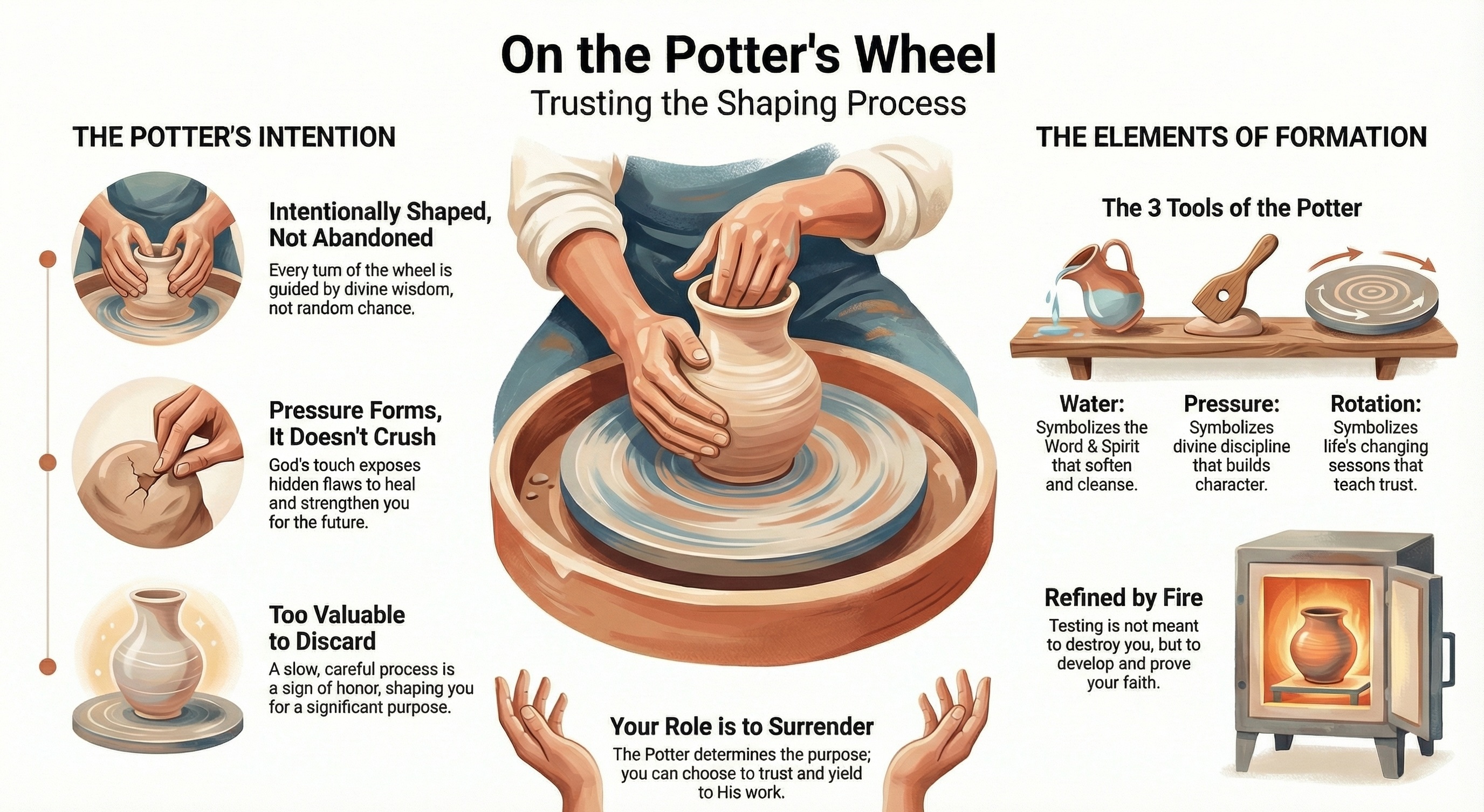
There are moments when God’s hands press firmly on the clay of your life. These moments, or even seasons, can often feel uncomfortable, stretching, or confusing, but they are not expressions of wrath; rather, they are moments of loving discipline and formation. They serve as evidence that the Potter is intentionally working on you with purpose. The Bible uses this image in Jeremiah 18:6, where God speaks to Israel through the picture of the potter and the clay, revealing His authority to shape what He has formed. Scripture later applies this image to individual lives as God works personally within His people.
You are not abandoned on a shelf or forgotten in a corner. You are not being spun by random circumstances or shaped by blind chance. You are on the Potter’s wheel, held by the hands of a Father who sees the masterpiece long before you recognize it yourself. You are loved, seen, and intentionally shaped.
Every pressure, every pause, and every turn of the wheel is guided by His wisdom and love. His touch is precise, and His timing is perfect. Even when you feel pressed down, He is not crushing you; He is forming you. When you feel stretched, He is not breaking you; He is strengthening you. Even when you do not understand His methods, His hands never slip, His movements are never careless.
Every spin, every trimming of excess clay and every reshaping is part of a holy and divine process. Sometimes, He removes something not to diminish you, but to make room for something greater. Isaiah 64:8 reminds us: “But now, O Lord, You are our Father; we are the clay and You our potter; and we are all the work of Your hand.”
To trust the Potter means believing that He sees what you cannot see. The clay does not understand the shaping process, yet it yields to the hands that mold it. In the same way, transformation requires surrender; it means trusting God even when His methods are beyond our understanding.
God is not finished with you. He has not abandoned His work or placed you aside. According to Philippians 1:6: “He who has begun a good work in you will complete it until the day of Jesus Christ.” He initiated the work, He continues to shape you, and He is faithful to bring it to completion as you continue yielding to His hands. The real question is not whether God is working but whether you will trust Him while He molds you.
In ancient pottery, the clay needed to be kneaded repeatedly to remove hidden air bubbles. If this process was neglected, the vessel could crack or be ruined in the kiln. In a similar way, God works to expose and remove real flaws, such as fear, pride, and resentment, not to condemn you, but to shape you into a healthier, stronger person who can both endure life’s challenges and reflect God’s character.
The Hebrew word for “form” in Genesis 2:7 is yatsar (יָצַר), meaning to fashion, shape, or squeeze into purpose. The same term is used in Jeremiah 18 to describe the Potter’s shaping. God formed you then and continues to shape you now.
In ancient pottery practices, clay was never casually discarded. If a vessel collapsed, cracked, or became misshapen on the wheel, the potter would soften the clay and begin again, because the material itself was valuable. Ordinary pots were formed quickly for common use, but vessels intended for honor were shaped slowly and carefully, often returning to the wheel multiple times. This illustrates how God works in our lives. When the shaping feels slow, repetitive, or persistent, it is not a sign of rejection or punishment, but of intention and honor. You are not being discarded; you are being shaped for something significant, eternal, and purposeful.
Spiritually, this parallel is profound. God presses into your life not to harm you, but to reveal what is hidden: unhealed wounds, buried fears, unconfessed sins, false beliefs, or old patterns that sabotage your future. If these hidden issues are left unaddressed, they can surface under pressure and prevent growth. His touch is not punishment; it is prevention and refinement.
During the shaping process, the potter uses three key elements:
- Water: Symbolizing the Word and the Spirit.
- Pressure: Symbolizing God’s shaping through conviction, pruning, and discipline.
- Rotation: Symbolizing the changing seasons and cycles of life.
God may use all three in your formation. His Word softens and cleanses, His shaping hand builds character, and the rotations of life teach stability and trust.
If life feels chaotic or if His hand feels firm, you are not failing; you are forming. You are being refined. In Scripture, fire is often used to describe testing and refinement. Fire strengthens, seals, and prepares the vessel to hold weight. As stated in 1 Peter 1:7, “That the genuineness of your faith, being much more precious than gold that perishes, though it is tested by fire, may be found to praise, honor, and glory at the revelation of Jesus Christ.”
God does not use fire to destroy you, but to develop you.
Romans 9:20–21 reminds us, in principle, that the Potter determines the purpose, not the clay, “Will the thing formed say to Him who formed it, ‘Why have You made me like this?’”
Some vessels are shaped to pour, some to store, some to serve quietly, and others to stand publicly, according to the Potter’s purpose and the clay’s yielded response. You do not choose your shape, but you can choose your surrender.
So, the question remains: Will you trust the Potter?
Did you know?
Research in cognitive behavioral science suggests that reframing challenges, choosing to view difficult experiences as opportunities for growth, is associated with lower anxiety and increased resilience. In simple terms, how a person interprets pressure significantly affects how they respond to it.
Scripture speaks to this reality long before modern research. James 1:2–4 instructs believers to consider trials as joy, not because hardship itself is pleasant, but because of what God produces through it:
“My brethren, count it all joy when you fall into various trials, knowing that the testing of your faith produces patience. But let patience have its perfect work, that you may be perfect and complete, lacking nothing.”
Both Scripture and research acknowledge that lasting transformation does not occur through avoidance or resistance, but through intentional engagement. Studies in behavioral science indicate that lasting change often involves both awareness and action. Likewise, spiritual formation deepens when a person reflects on what God is revealing and responds in obedience.
Transformation becomes tangible when you cooperate with God’s shaping instead of resisting it. Reflection helps you recognize where He is working, while surrender allows His work to continue.
Charles's Story
The following story is not an assignment. It is a real testimony that shows how these truths can look in a real person’s life.

Charles grew up feeling like life was something done to him rather than something he participated in with God. For years, he lived under a heavy sense of anxiety, depression, and emptiness that no amount of accomplishment, control, or effort could ever fill. At times he tried to numb himself, through work, entertainment, and habits that only pushed his pain deeper into the background. He felt distant from God, unsure if God even noticed him, and certain that his struggles were proof that he was on his own.
For over a decade, Charles wrestled with fear and self-condemnation. When pressure hit, he internalized it as failure. When relationships fractured, he assumed he was unworthy. When he felt joy, it was fleeting and fragile. In quiet moments, he would whisper prayers, but they felt like echoes in a hollow place. “God, if you are real, please make me whole,” he prayed often, hoping for a sudden breakthrough that would end the pain. But the breakthrough he expected never came all at once.
In a turning point, Charles realized that what he most needed was not a fix, but a change of heart. He began to seek God not just for relief from discomfort but for transformation in how he lived day by day. He started praying with honesty, acknowledging not just what he wanted God to take away, but what he wanted God to do within him. He opened his Bible not to find the easiest verses, but to let Scripture speak into his fear, insecurity, and old patterns of thought. He let God’s Word confront the anxious narratives he had believed for years.
Then one day, everything inside Jackie broke open. A relationship she cared about deeply fell apart, triggering memories from her childhood she thought she had buried. That old tension returned, not as a whisper but as a roar. Panic and old thoughts reeled through her mind. On a night she could not sleep, clutching a pillow and feeling hopeless, she cried out differently. Not asking God to fix her, but telling Him her pain, her confusion, and her fear. For the first time, she spoke to God honestly, without pretending or trying to manage it herself.
At first, the change was subtle. Charles still felt fear. The old burdens did not disappear. But he began to notice responses forming where once there were only reactions. When fear rose, he prayed instead of withdrawing. When discouragement whispered that God did not care, he reminded himself of God’s promises and read Scripture until truth replaced the lies. He also opened up to a community of believers who prayed with him, encouraged him, and helped him see evidence of God’s work in his life.
Charles learned that healing was not a one-time moment of relief but a of daily surrender. Some mornings he woke up and found that he no longer feared the future the way he once did. Other days he still wrestled with old thoughts, but he now knew where to bring them, into God’s presence. Over time, what once felt like weakness became fertile ground for God’s strength. The trials that once crushed him became spaces where he learned trust, obedience, and dependence.
As Charles continued to yield his life to God, he saw that God was not punishing him with pressure. God was shaping him, molding his character, reshaping his priorities, and teaching him how to trust in God’s hands even when the process was confusing or slow. He began to say the prayer that marked his transformation: “Lord, I don’t understand this, but I trust Your hands.” And those words became not just a prayer, but a way of life.
Charles now looks back and sees that God did not abandon him when life felt hardest. Instead, God was there in every moment of surrender, every prayer spoken in weakness, and every step of faithful obedience. What once felt like scattered broken pieces has now become a life that reflects God’s patient work. He learned that the shaping never stops until God’s purpose is complete, and that trusting the Potter is the greatest work of all.
Optional Reflection
This reflection is completely optional. Your responses are not submitted, shared, or saved anywhere. They are for your personal reflection or group discussion only. If you choose to write responses, you may print or save them for yourself.
Charles’s story may not look exactly like yours, but many people recognize the experience of life feeling heavy, confusing, or overwhelming before they discovered how God was shaping them through it.
Take a few quiet moments to reflect on Charle's story. and how it may relate to anything in your own life. This is not about giving the “right” answer, but about being honest with God and trusting that He will help with whatever you bring to Him.
When you are ready, continue to the learner response page and follow the guidance of your pastor or church leader. Your reflections may be used for personal study, group discussion, or submitted as part of a church dicipleship course, as directed.
📝 My Notes
Log in or create a free account to take private notes and highlight passages.