Step 3 of 15
1.2 Healing and Renewal
Lesson 1: Created With Purpose
Section Reading
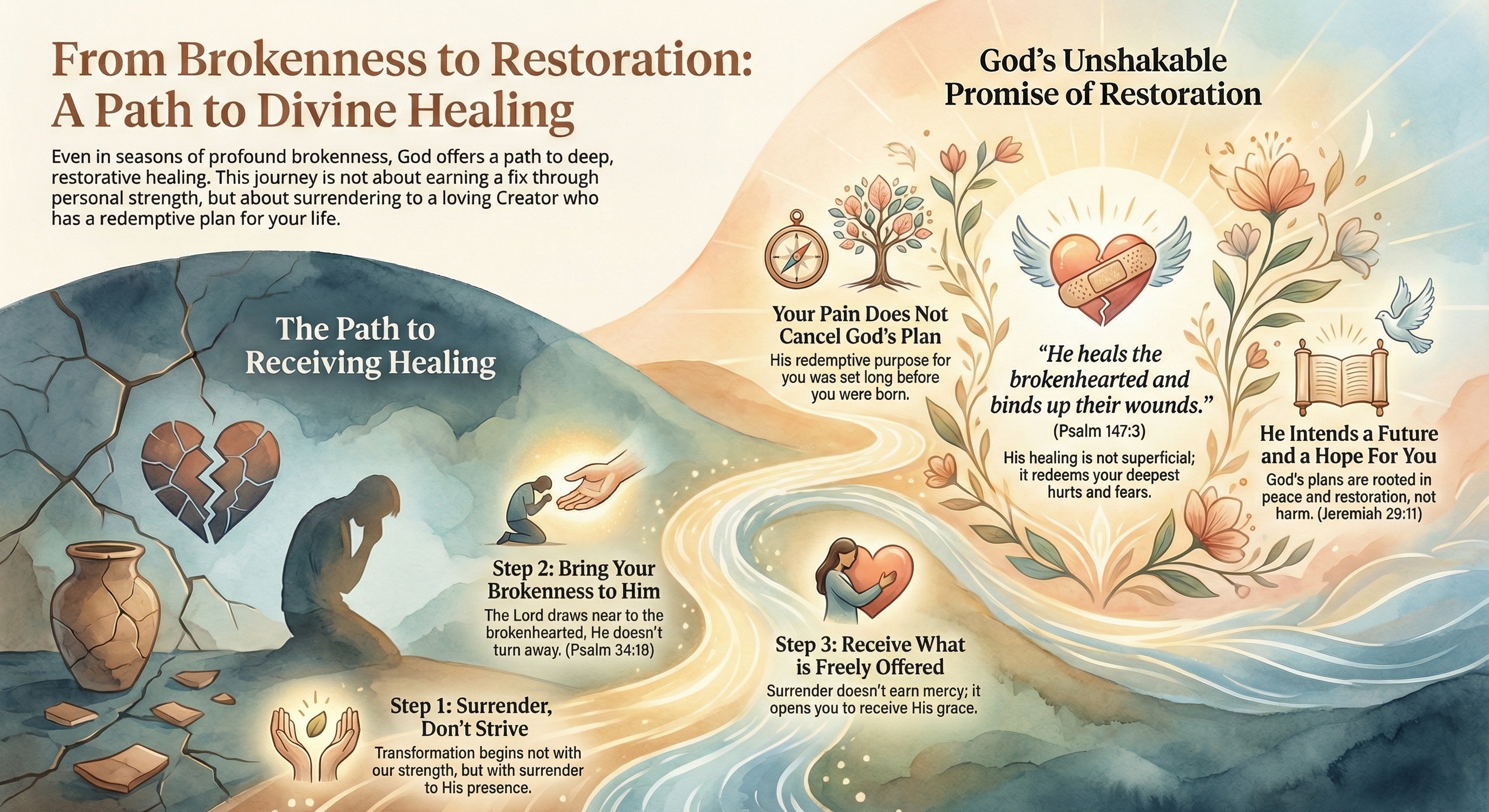
Each of us has experienced seasons of brokenness; moments when life feels shattered, direction seems lost, or hope appears out of reach. However, even when life feels broken, His redemptive intention has not changed for you.
Your brokenness does not define you; Jesus alone restores and brings new life through salvation. Long before you ever took your first breath, God’s foreknowledge and redemptive intention were already at work. The Bible reveals that God acts according to His purpose and foreknowledge, as seen when He said to Jeremiah, ‘Before I formed you in the womb I knew you’ (Jeremiah 1:5).
The enemy may whisper that your life has no value, but God’s voice speaks the opposite. Your pain does not cancel God’s plan, and hardship does not remove His calling. What has happened to you does not erase God’s intention as your Creator, but Scripture teaches that His purpose is entered and fulfilled only through repentance, faith, and obedience to Him.
Many people spend years trying to earn their worth or fix what feels broken inside. But in Genesis 1:27, the Bible tells us a truth we must understand: “So God created man in His own image; in the image of God, He created him; male and female He created them.”
Psalm 107:20 says, “He sent His word and healed them, and delivered them from their destructions.” God’s healing is not a superficial fix; it is deep restoration. Jesus came not only to rescue you from sin but also to heal, restore, redeem, and lead you into the abundant life He intended. As stated in John 10:10, “I have come that they may have life, and that they may have it more abundantly.”
Scripture teaches that healing does not begin with discovering identity, but with bringing brokenness to Jesus in surrender and faith. Healing begins when you bring your wounds to Him, because He draws near to the brokenhearted rather than turning away from them. As Psalm 147:3 declares, “He heals the brokenhearted and binds up their wounds.”
Healing is not only possible; it is a work God faithfully offers according to His will and purpose. What is impossible for us is not impossible for Him. Luke 1:37 reminds us, “For with God nothing will be impossible.”
It’s important to understand that healing does not start with our own efforts; it begins with Jesus Himself. Scripture affirms this in Psalm 34:18: “The LORD is near to those who have a broken heart, and saves such as have a contrite spirit.” Even the parts of your story that feel broken, painful, confusing, or hidden are fully known to Him, and He loves you despite them.
Jeremiah 29:11 reveals the heart and character of God toward His people, declaring, ‘For I know the thoughts that I think toward you,’ says the Lord, ‘thoughts of peace and not of evil, to give you a future and a hope.’ This passage shows that God’s plans are rooted in restoration and hope, even in seasons of hardship.
God’s healing reaches into the deep and hidden places that no one can see. It touches the patterns you struggle to break, the wounds you cannot heal, the fears that still shake you, and the memories that continue to haunt you. Nothing is too deep for God to redeem.
Because God’s healing is relational rather than mechanical, it is experienced as we allow Him to enter those places. Jesus restores the whole person. Abundance does not mean life without hardship; rather, it means having Him step into your pain, strengthen what is weak, and fill what has been empty. Healing begins with surrender to God. James 4:7 says, “Submit yourselves therefore to God. Resist the devil, and he will flee from you.” Transformation does not begin with our strength, but with surrender to His presence.
God’s mercy originates with Him, not with us. He freely offers mercy, healing, and restoration according to His grace, not our effort. Surrender does not earn that mercy; it is the response by which mercy is received. God does not force Himself upon us, but when we turn toward Him in humility and surrender, we position ourselves to receive what He has already given. Scripture affirms this invitation in Hebrews 4:16, which calls us to come boldly to the throne of grace to obtain mercy and find grace to help in time of need. Our step does not produce mercy; it opens us to receive what God freely offers.
As you walk with Him, God continues His work of renewing your mind, shaping discernment, refining your thoughts, and directing your purpose. Jeremiah 31:3 says, “I have loved you with an everlasting love; therefore, with lovingkindness I have drawn you.” God does not abandon what He starts. Even when we are unfaithful, He remains faithful (2 Timothy 2:13); yet Scripture teaches that we experience the fullness of His work as we continue walking with Him in surrender and obedience. In John 8:31 Jesus said, “If you abide in My word, you are My disciples indeed.”
Did you know?
Research in neurobiology, trauma recovery, and emotional healing shows that renewal occurs when the brain develops new pathways through repeated experiences grounded in truth, gratitude, healthy emotional expression, and spiritual practices.
Scientific studies indicate that reflective practices such as gratitude, expressive writing, and focused contemplation support activity in areas of the brain associated with emotional regulation, peace, and resilience. This aligns with Scripture’s call to renew the mind (Romans 12:2), cast our cares on God (1 Peter 5:7), and meditate on His Word (Psalm 1:2–3).
What science refers to as neuroplasticity can be seen as an observable parallel to the Bible’s language of transformation, restoration, and renewal by the Spirit. True healing integrates both: God’s eternal Word and the mind He designed, working together to reshape a person from the inside out.
Jackie's Story
The following story is not an assignment. It is a real testimony that shows how these truths can look in a real person’s life.

Jackie’s life was shaped by survival long before she ever considered God. As a child, home was a place of unpredictable anger and silent nights where she learned to stay quiet, to watch, and to brace herself for what might come. She did not call it fear growing up. It was just normal. She figured everyone felt the same. When she got older, she worked hard to appear put together, but underneath she carried a constant tension, shadows of insecurity, old memories that flared at unexpected times, and an emotional ache she could never explain.
For years, Jackie pretended the past did not matter. She worked, performed, and smiled through holidays and gatherings, hoping people would think she was fine. But when stress hit or old memories surged, she spiraled inward. “Why does this still hurt?” she wondered. “Why do I still react this way?”
Sometimes she blamed herself. Sometimes she blamed the world. But she never blamed God, because she did not believe God even saw her that closely. Jackie did not grow up in church. God was something distant, a story adults told, not a presence she felt. She sometimes prayed late at night, but it was mostly out of exhaustion, not faith. “God, if you are real, please take this heaviness away,” she whispered more times than she could count. She imagined healing as a single moment, a sudden vanishing of pain and shame, like a light switch being flipped. But life did not work that way.
Then one day, everything inside Jackie broke open. A relationship she cared about deeply fell apart, triggering memories from her childhood she thought she had buried. That old tension returned, not as a whisper but as a roar. Panic and old thoughts reeled through her mind. On a night she could not sleep, clutching a pillow and feeling hopeless, she cried out differently. Not asking God to fix her, but telling Him her pain, her confusion, and her fear. For the first time, she spoke to God honestly, without pretending or trying to manage it herself.
In that moment, Jackie sensed something different. A presence that was gentle, not distant. A voice that invited her to lay her hurt down rather than carry it alone. It was not a flash of perfect peace, but it was real. She prayed, “God, I do not know how to do this, but I want You to have this part of me.” and instead of silence, she felt a newfound calm that stayed with her long after the tears stopped.
Healing did not come all at once. Jackie still struggled. Some days old patterns returned, and she had to intentionally turn to God again. But she learned a new pattern. When pain surged, she prayed. When shame rose, she read Scripture. When she felt alone, she reached out to her church community for prayer. She began to understand that healing was not about erasing the past, but about bringing it into God’s presence and letting Him meet her there.
Some mornings, she woke up and realized she no longer feared memories the way she used to. She found that life with God did not remove every hurt, but it changed how she faced them. What used to feel like damage was now a place of reliance, a space where she learned daily to give her broken pieces to Jesus, letting Him shape her into someone who trusted Him even when healing was slow.
Jackie learned that God heals not by avoiding pain, but by walking with her through it, teaching her to surrender fear, to always pray, and to let the word of God reshape her identity. Her broken past did not vanish, but it became part of her testimony of surrender, trust, and the God who restores even the places no one ever saw.
Optional Reflection
This reflection is completely optional. Your responses are not submitted, shared, or saved anywhere. They are for your personal reflection or group discussion only. If you choose to write responses, you may print or save them for yourself.
Jackie’s story may not look exactly like yours, but many people can relate to carrying pain, fear, or brokenness from the past. When wounds resurface or memories return, it can be tempting to withdraw, self-protect, or try to manage the pain on your own.
Take a few quiet moments to reflect on Jackie's story and how it connects with your own struggles. This is not about giving the “right” answer, but about being honest before God and yourself.
When you are ready, continue to the learner response page and follow the guidance of your pastor or church leader. Your reflections may be used for personal study, group discussion, or submitted as part of a church dicipleship course, as directed.
📝 My Notes
Log in or create a free account to take private notes and highlight passages.